
Visit us at our new home!

For new daily content, visit us at our new blog: http://www.acrinv.com/blog/

Wednesday, July 2, 2008

Daily Insight

U.S. stocks ended a pretty wild session in the black as investors pushed aside another day of speculation regarding the likelihood of an Israeli attack on Iran’s nuclear installations and higher oil prices to focus on better-than-expected manufacturing and construction spending reports.

Stocks gained some steam early in the session when the ISM (Institute for Supply Management) survey showed factory activity expanded in June, but gave it back quickly as oil prices jumped on the Middle East news. The Pentagon released a statement mid-day dismissing the news and oil prices pulled back; stocks gained ground as crude fell from the session’s highs.

(With all of this talk of a strike, and Israel’s military exercise last month preparing for what may be the inevitable, Iran is suddenly inviting the idea of talks over their nuclear activities. Of course, this is what Iran does; they act as though they are serious about keeping to their end of the bargain, while they buy time and continue to enrich uranium to weapons grade status. The Israeli’s understand this and prudently prepare for action considering the regime continues to makes statement such as “Israel will be wiped from the map.” The market is currently trying to assess the appropriate multiple due to this uncertainty, among others.)

Market Activity for July 1, 2008
The S&P 500, as the chart below illustrates, had been down as much as 1.5% from the opening price, but jumped nearly 2% from those lows to close the session meaningfully higher. Financial, consumer discretionary and energy shares led the broad-market’s advance. The Dow’s gain was propelled by shares of American Express, Proctor and Gamble, McDonalds and Wal-Mart.

Advancing stocks just about matched decliners on the NSYE. Some 1.58 billion shares traded on the Big Board, slightly more than the three-month daily average. For this July 4th holiday-shortened week, volume is usually much lower, but with the June jobs data release coming on Thursday, traders likely delayed vacation to be around for this all-important report.

On the economic front, the latest manufacturing report showed factory activity expanded in June, marking the first move above 50 (the level that divides expansion and contraction) since January. Even so, during the previous four months of contraction, the index was just barely below the line of expansion and no where near the level that indicates trouble.

The Chairman of the Institute for Supply Management explained in the report, as we’ve touched on in the past, that when the survey averages 50 it corresponds to roughly 2.8% real annualized GDP growth. During the second quarter ISM averaged 49.4, so we’re looking at a GDP reading of about 2.6% by this indication.

(I believe we will see a number in that range as increased capital goods shipments, higher personal consumption numbers and the production needed to rebuild low inventory levels will catalyze growth. Housing will continue to subtract a full percentage point from the reading; if housing were merely flat, GDP would come in at 3.5% for Q2, but this flattening will not take place until the supply of homes comes down significantly – which will probably take another year, hopefully.)

In a separate report, the Commerce Department reported that construction spending fell less-than-expected in May, declining by 0.4% -- the consensus estimate was for a 0.6% decline. The April reading was revised higher to show a 0.1% drop, after previously estimated at a 0.4% decline.

Two months of declines surely doesn’t give one a sense of full-flowing optimism, but considering the residential component – which makes up 40% of this reading – was down 1.6% in May (and off by 26.9% year-over-year) these mild declines are relatively good news. Strength came from lodging construction (up 2.6% for the month), schools (up 1.6%), power plants (up 1.5%) and manufacturing facilities (up 0.9%).

Lastly, the auto industry released its sales data for June, and the turn down of the past three months continues. But lower sales volumes are not the result of a lack of credit availability or even demand. Instead, according to the report, there is just too much supply of trucks and SUVS and not enough of what consumers currently desire during this period of high fuel prices – more fuel efficient vehicles.

Over the next several months manufacturers will undoubtedly ramp up production of the cars people want in this environment and unless something changes with regard to the job market – which is currently soft but not showing statistically significant declines – sales should rebound several months out.


Have a great day!

Brent Vondera, Senior Analyst

Tuesday, July 1, 2008

Is no-load mutual fund investing all people need?

David Ott made another appearance in the St. Louis Post Dispatch writing for the ASK THE EXPERT column. This time David discusses how Acropolis feels about index funds and how they are used in client portfolios.

Click here or on the icon below to check it out!

Daily Insight

U.S. stock indices ended mixed on the final day of the second quarter as the Dow and S&P 500 managed small gains, while the NASDAQ Composite closed lower. The opposite was the case for the quarter, however, as the Dow and S&P 500 ended the period lower – the third-straight quarter of losses – and the NASDAQ managed a fractional gain.

The Dow closed the quarter down 7.44%; the S&P 500 declined 3.23%; the NASDAQ Composite gained 0.61%

The Dow’s string of three consecutive quarterly losses has not occurred since 1977 when the index recorded losses in each of that year’s four quarters. (For the S&P 500 we have had two other occasions since 2000 when the measure was off for three straight quarterly periods – first nine months of 2002 and the final nine months of 2000.)

We don’t want to get ourselves into a situation where comparisons to the 1970s become relevant, especially with regard to inflation. And on that topic, Bernanke & Co. better well get a handle on benflation expectations or stock prices may just begin to price in harmful levels of price activity – even as the consumer-level gauges remain pretty tame for now. One cannot ignore the jump in energy prices, and commodities in general, or suggest that these costs will come lower simply because economic growth is weak. This is what the Fed has been saying, and the thought has been terribly wrong to this point; I’ve got a sense they’ll be forced to throw their Keynesian-style thinking aside in the very near term.

Market Activity for June 30, 2008
The financial sector, to no one’s surprise, led the broad market lower for the quarter as the index that tracks these shares tumbled 19.01%. The next worst performer was the industrial group. Six of the 10 major industry groups declined during the prior three months.

Energy, again no surprise, led the gainers, jumping 16.92% for the three months ended June 30, as oil jumped 38%. Such a quarterly increase (in percentage terms) has not occurred since 1999, but back then oil per barrel was trading at $12-$16 per barrel, so it was just a touch easier to deal with. The lunatic fringe may begin to surmise that Bernanke has some family members with oil-company interests if this pace continues. This would be an illogical view, but there’s little arguing his easy money ways hasn’t had adverse effects on the dollar and the price of oil.

Interestingly, removing the financials from the S&P 500 the index was basically flat during the prior three months, down just 0.38% -- financials were responsible for 285 basis points of the 3.23% decline. I’m not sure if thinking of things this way makes much sense, but thought it was worth pointing out. Financials make up 14.2% of the S&P 500 at present, which is down from 16.8% when the quarter began and 21.42% just two years ago.

I look at the benchmark indices, and many of the stocks that make up these measures, and see a lot of value. There are an abundant number of stocks trading at multiples that have compressed to levels that make very little sense based on their current earnings growth and potential of the next several years. In time the equity indices will explode to the upside as stocks are spring loaded after several years of earnings growth far outpacing the rise in share prices.

But for now, investors will simply have to be patient because uncertainties abound and the Fed has thrown one more in with their easy money policy. Maybe I’m way off base here, but as most readers know, my belief is oil will fall back to the $100-$110 level if Bernanke would just mildly raise rates. This would bring inflation expectations lower and remove a major risk (not just on an expectations level but will relieve some pressure on the consumer) as we deal with the current housing-sector woes and concern over tax and trade policy – a concern that increases each day Senator Obama makes a speech about how he’s going to jack rates up on the people that provide our economy with capital, which is about every day by my count. In addition, placing windfall” profit taxes on oil producers (more production is something we can really use right now) won’t be kind either as this will increase out dependence on energy imports, just as the same scheme drove the industry to other areas of the globe during the late 1970s.

Enough of that. On the economic front, the Chicago Purchasing Manager’s report – factory activity for the most important manufacturing region – showed mild improvement within the sector continues, as the index crept even closer to the expansionary mark.

The reading came in at 49.6; a reading of 48 was expected. As we’ve stated for a few weeks now, it does appear the manufacturing sector is poised to record expansionary reading once again – it’s been six months since we’ve been solidly above the line of expansion, which is 50 on these indices.

Yes, it will take a flattening out in housing before factory activity moves markedly into expansion mode – by markedly we mean readings of 55-56. However, we are already right at the line of demarcation and should mover above the 50-mark within a couple of months – even with current housing and auto-industry challenges.

We’ll get a better look this morning when the national factory index – known and ISM Manufacturing – is released. We’ll have to deal with another reading that remains just barely in contraction mode, but should see some signs that things continue to slowly improve as underlying strengths help the sector fight through the areas of weakness.


Have a great day!

Brent Vondera, Senior Analyst

Monday, June 30, 2008

Daily Insight

U.S. stocks fell on Friday, adding to Thursday’s rather large declines, even as the day’s economic data looked quite healthy. But the typical pessimistic tone related to those economic releases, which always seem to tell only part of the story (funny how it’s always a negative commentary), and another day of higher oil prices – as the Fed remains lost in the wilderness of their Keynesian textbooks – was too much for investors to bid the indices higher.

As a result of Friday’s nearly 1% decline on the Dow, the index has virtually moved to bear-market territory. The S&P 500 remains roughly 2% from bear-market levels – which are defined by falling 20% from the top. That top was reached on October 9. The graphs below illustrate was has occurred over the past two years, and specific to this discussion over the past nine months.

Market Activity for June 27, 2008

Today marks the final day of the third quarter and things aren’t looking real nice as the broad market is set to decline 3.4% for the past three months. The poor quarterly results are due to the worst June performance since 1930 – down 8% this month with the final session to go. We were off to such a good quarter too as April was up 4.75% and May add another 1.07%. But oil prices have proven to be too much for the market to handle. Sure, we have a soft labor market and the questions as to the duration of the housing correction, but let’s face it the job-market declines have been mild and housing has been baked in for a while. It’s mostly about the direction of energy prices at this point.

Crude-oil futures picked up another 60 cents on Friday, closing the session above $140 per barrel. Crude has jumped 2.2% thus far this morning, moving above $143. I simply don’t see this situation changing until the Fed gets a clue and begins to overtly signal, and then follow words with action, they will begin to raise rates. As we’ve touched on many times, they do not need to raise their benchmark fed funds rate much, just a gentle climb to 3.00% by year end. This will take the steam out of the oil trade and do some amazing things in terms of causing the inflation gauges to decelerate. (Remarkably, the consumer-level inflation indicators remain remarkably tame. This is not so for the producer price and import price gauges, which are through the roof and the worry is that these levels will eventually end up moving to the consumer level. But this has not yet occurred.)

But back to the Fed for a moment, their current decisions are causing traders to keep their long positions regarding the oil trade and have led others to move in as well. According to Bloomberg News, net long positions in New York oil contracts jumped 90.5%. Long positions had touched a five-week low a week earlier as many believed the Fed would make a strong statement that the rate-hiking campaign would begin at their August meeting. Now that another meeting has come and gone, and they were pathetically non-committal with regard to policy, the oil trade goes on.

In addition to all of that, we also have geopolitical concerns pushing oil futures higher this morning, as worries about Iran pick up. Still, I don’t think I’d want to be long oil futures right now. It is a matter of time before the Fed begins to raise rates, they’ll be forced to, and oil should come off big when they do. Geopolitical concerns will remain, but this is why one keeps an allocation to energy and the stocks that provide the equipment to the industry.

On the economic front, the Commerce Department reported that personal incomes shot up in June, jumping 1.9% and sending the year-over-year increase to 6.4%. But much of this was due to rebate checks and the government transfer payments that also went out but were not officially termed “rebate” checks.

During June, $48 billion of rebate checks were delivered so when we adjust for this one-off incomes rose 1.3% last month, still a huge reading. However, there was a purely Keynesian aspect to this “stimulus” program that resulted in people getting checks that were actually more than their actual federal income tax liabilities for 2007. Part of the program was to essentially eliminate the 10% bracket, that’s how they came up with the $600 rebate for most individuals and $1200 for most couples. But others got money as well – a handout is the appropriate term.

You see anyone with income of at least $3,000 in 2007 got at least $300, and since federal tax rates have been driven to zero for individuals making up to $10,000 and couples making up to $20,000, their checks amounted to more than they paid in taxes and those payments were termed “social benefit” outlays. Put all of this together and there were $176.5 billion in government payments that boosted the June income figures. Still, what the media failed to report was that even when you adjust for all of this, June incomes still rose $49 billion, resulting in a 0.4% pick up in incomes for the month. That’s a healthy reading.

I’ve expressed some concern over income growth, especially with energy prices pushing higher, but even when we adjust for the government handouts, June looked good.

Spending jumped 0.8% in June, and has been quite strong from three months now – up 6.8% at an annual rate --, bouncing back very nicely from the respite consumers took during the first couple months of the year. Interestingly, there was $226 billion in income last month when adding in the government handouts, but spending rose just $77.4 billion. Hence, the majority of the “stimulus” handouts were saved, or used to pay down debt.

Overall though, the income (adjusted for the government checks) and spending figures looked good in June and remain on a solid trajectory. Unfortunately, the pace at which energy prices are rising is impossible for income growth to match. In time, very near term in my opinion, the Fed will do its part and this will not be the worry it is today. Their action is belated, but they will be forced to raise as oil will not begin a downtrend until they do.

We’ve got a huge week regarding economic releases. Today we begin with the most important regional factory index – that being Chicago. Tomorrow we get the national reading, which should show manufacturing activity remains very close to expansion mode even as housing and auto-industry woes weigh on the figure. Construction spending for May will also be released on Tuesday. On Thursday we round out the holiday-shortened week with the all-important jobs data for June.

Have a great day!

Brent Vondera, Senior Analyst

Friday, June 27, 2008

The Wall Street Transcript

The Wall Street Transcript interviewed Chris Lissner for the October 2007 issue. This is an excellent read for anyone wanting to learn more about Acropolis, it's investment strategy and security selection process. Click here or the icon below to read the interview.


Daily Insight

U.S. stocks took a beating yesterday as the Fed has created additional problems for equity investors after failing to provide strong and decisive language regarding near-term monetary policy. The lack of conviction is making it difficult to assign an appropriate market multiple to the broad market as inflation concerns increase; oil has gotten back on its horse and seems quite ready to move higher so long as the FOMC remains non-committal.

The Dow Industrial average moved to its lowest level since September 2006 and the Dow Transports have gotten hammered in the past five trading sessions, falling 7.5%. Still the trannies have held up remarkably well, up 7% year-to-date. The S&P 500 has held above the March 10 multi-year low, but just barely as a 1% decline from here will move us through that level.

Market Activity for June 26, 2008
For what it’s worth, the U.S. indices are holding up better than most markets. Year-to-date, Germany is down 14.12%; France is off by 15.57; Britain is down 14%; Spain has declined 14.10% -- and that’s with currency adjustment. In addition, Hong Kong is down 20.7%; China’s major index has plunged 45%; India is off by 32%.

Crude-oil futures, enabled by the Fed and the driver of Benflation, rose 3.78% yesterday and are adding to that move this morning, rising above $140 per barrel. The chart below shows activity for yesterday’s session. Some of this activity includes the previous day’s overnight session, but you can tell by the time on the x axis how momentum began to build early morning and exploded to the upside by the time of our market open. (That momentum actually occurred directly following the release of Wednesday’s Fed decision as crude, which had been lower for most of the day by $4, reversed course and recovered half of that loss.

On the economic front, the data wasn’t too bad really, actually quite good regarding the GDP when considering all of the recession predictions.

Oh, before getting into that, I neglected to mention yesterday that Oracle’s latest earnings results were strong, propelled by the U.S.-dominated Americas region. Overall, quarterly profit advanced 27%, with U.S. sales bouncing back to record 18% growth.

As we’ve talked about many times, there are certainly areas of the U.S. economy that are hurting – housing and autos, namely – but other segments remain quite healthy. This news out of Oracle is just another example. A prime example of this reality, which we touch on each month, is business sales, which are up 6.75% over the past year and have increased at an 8.5% annual pace thus for during 2008. This data does have a big lag to it; the latest data is for April. That said, based on the trends of May and June, I expect this data to remain on an upward trajectory.

But back to yesterday’s economic releases, the Commerce Department reported that first-quarter GDP was revised slightly higher to 1% at an annual pace – that’s in real term, adjusted for inflation.

The drivers of first-quarter activity were personal consumption – always the largest segment of growth --, which added 0.81 percentage point; net exports, which added 0.79 percentage point; and government spending, adding 0.41 percentage point.

The drag continues to be residential fixed investment – housing --, which subtracted 1.12 percentage points from that real GDP figure. This amounts to a 24.6% decline at an annual rate – again, this is for housing construction.

Inventory additions added virtually nothing to first-quarter GDP, after subtracting a large 1.79 percentage points from the fourth-quarter number. Watch as the production needed to rebuild inventories fuels second-quarter GDP. Personal consumption and business spending will also add nicely, and unless the lagging data (mostly for June, but we still have a couple of releases we have yet to see for May) record uglier numbers than I’m expecting, the next GDP report will be stronger than most estimate and will continue to crush the recession predictions.

Growth is certainly weak, but it’s a far cry from recession – traditional definition of which is two-straight quarters of negative readings. My main caveat at this point is the Fed. They are fueling a commodity boom and their latest statements make it appear they are oblivious of this fact. They continue to believe that weak growth will bring these prices lower – I guess we’ll watch this assessment continue to miss the mark. If they don’t wake up, the interest rate increases that will be necessary to regain inflation-fighting credibility will lead to recession in the back-half of 2009.

In a separate report, the National Association of Realtors reported that existing home sales rose 2.0% in May. That’s certainly welcome news, but the inventory levels remain extremely elevated – as the second chart below illustrates -- so it’s tough to get excited about the increase in sales. Fact is this housing correction will be with us for a while. If only the Fed would get it right we will adjust to the housing woes. Assuming Congressional chicanery doesn’t exacerbate the situation, my feel is housing will begin to flatten out a year from now.

It’s important to point out that real economic growth has increased 2.5% over the past four quarters. That’s with housing subtracting more than one percentage point during three of those quarters and high fuel prices that continue to rise. For perspective, the long-term average for real U.S. growth – or what is referred to as “trend growth” – is 3.4%.

Lastly, the Labor Department reported that initial jobless claims came in flat from the previous week’s reading. For the week ended June 21 claims remained at 384,000, which is a bit higher than we would like. In the currently soft job market environment, we’d like to see claims hovering around 365,000-375,000 – this level would give us confidence that the monthly job losses would remain very tame. The current level of claims is not terrible, so long as we remain below 400,000 it is unlikely we’ll see a sharp monthly decline in payroll jobs, but still a small decline from here would make me more comfortable especially regarding the outlook for income growth.

This morning we get the May figures for personal income and spending, along with the inflation gauge tied to it all.

It will be tough for the equity markets to advance today, as traders will not want to go into the weekend long with the uncertainties that surround. But if the income and spending numbers come in at a healthy pace, stocks could get a boost. The inflation gauge tied to personal spending – known as the personal consumption expenditures index, or PCE – will show consumer-level inflation remains fairly tame. But this will change if the import and producer price figures remain at current levels and the Fed fails to put the hurt on the oil trade. If they fail to get it right, we’ll see the inflation gauges hit 4.5%-5.0% and then the bozos will be forced to act.

Have a great weekend!
Brent Vondera, Senior Analyst

Thursday, June 26, 2008

Daily Insight

U.S. stocks ended the session higher, but traders appeared confused during the hour of trading subsequent the Fed’s rate decision – and just as importantly the statement, which was extremely non-committal – as the major indices gyrated more than 1%, as the graph below illustrates. In the end the indices held onto to most of the pre-announcement gains.

During the morning session, stocks shook off another very weak new home sales number – this time for May – as a pretty good durable goods report helped investor optimism. That report showed orders were flat for May, but electronics, computer products and telecommunication equipment showed nice gains and shipments of capital goods, which flows directly to the GDP figure, gave good indication second-quarter growth will be stronger than expected. More on this later.

Market Activity for June 25, 2008
Crude oil futures fell roughly 4% as the weekly energy report showed supplies rose 803,000 barrels – the forecast was for a decline of 1.1 million barrels. Fuel demand averaged 20.2 million barrels per day during the past four weeks, down 2.3% from a year earlier. Crude recovered half of this decline after the Fed’s comments showed they still don’t get it, which we’ll also get to below.

Eight of the 10 major industry groups gained ground for the day; energy and industrials were the losers. Energy was down on the decline in crude futures and industrials were pushed lower by a nearly 7% decline in Boeing shares, which sent many of the aircraft suppliers down in sympathy. But this concern was overplayed and the suppliers, especially those with strong defense contracts, are looking quite attractive here. The decline in Boeing shares subtracted 41 Dow points from the index, which is why it lagged the performance of the S&P 500.

Getting to the economic data, new home sales fell 2.5% in May, brining sales to 512,000 at an annual rate. There’s not much more to say about this situation, you’ve all heard it before. Supplies are terribly elevated and buyers simply will not come back to the market in earnest until they get a sense that prices have bottomed.

Expect housing – residential fixed investment in technical terms – to continue to weigh on the GDP figures, which has been the case for nine quarters now. During eight of these quarters, housing has subtracted at least 1.25 percentage point from real growth, yet economic growth has still measured 2.35% in real terms during this nine quarter period. Add in the 1.25 percentage point and you’ve got above trend growth even with sky-high energy prices – that proves underlying strength remains.

I’m guessing housing will bottom sometime in mid-2009, but this assumes Congress doesn’t do anything stupid to prolong the correction, which is a big assumption.

In a separate report, the Commerce Department reported that May durable goods orders came in flat. What kept the figure flat from the April reading was a big drop in machinery orders, down 5.3%. Strong orders in April and March – up 5.1% and 8.5%, respectively – caused the machinery orders respite. Vehicles and parts also weighed on the figure, which as been a reality for several months now. Those orders were down 3.5% and many auto plants remain idle.

The strength came from electronic, computer products and telecommunication equipment, which all posted really nice gains. Electronics orders were up 2.0%; computer products orders were up 10% and telecom orders rose 2.4% for the month.

Non-defense capital goods ex-aircraft – a proxy from business spending -- slipped 0.8% in May due to that drop in machinery orders. The decline followed a 3.1% rise in April. Importantly, shipments of business equipment rose 0.6% last month, which was on top of a 0.9% increase for April. This number is a component of GDP and thus will help the Q2 reading.

Finally, getting to the big news of the day, the FOMC (Federal Open Market Committee) kept their benchmark interest rate unchanged and the statement that accompanied the decision was non-committal.

The Fed mentioned overall economic activity continues to expand, reflecting some firming in household spending. However, they also mentioned that labor markets remain soft and that the housing correction and high energy prices will likely weigh on economic growth.

This latter statement was damaging. We already know this and all stating it does is send a signal that they may not raise rates in August. This is bad for the short-term price of oil – we needed a strong statement proving Bernanke and Co. understand that a mild boost in fed funds will bring crude futures lower.

The Fed certainly stuck to their Keynesian roots by mentioning they expect inflation to moderate later this year simply because growth is weak. This has been their line for six months now, only to be way wrong as their easy money campaign has hit the dollar and boosted commodity prices.

I’ve got to say my initial reaction to the statement was that it did signal the rate-hiking will begin in August – basically because of the “economic activity continues to expand, reflecting some firming in household spending” comment. Alas, the market didn’t see things the same way.

I lament, the language was not nearly strong enough – they needed to be much more hawkish towards commodity-price inflation. This was evident shortly after the comments were released as the dollar declined – after being flat-to-higher prior to the statement; oil reversed course – erasing half of it earlier losses – and the probability of a rate hike in August (their next meeting) declined.
Overall, the FOMC release was a big let down and we’ll likely have to deal with a dollar that struggles to gain ground and thus oil prices that remain above $100 per barrel, possibly above this $130 mark as the Fed is directing short-term traders to stick to the commodity trade.

There will be a new Fed Chief by the end of 2009. Bernanke is a fumbler and fails to get what will actually help economic growth in the relative short term.

This is a confused Fed. They certainly have a tough job in front of them, but they must understand that 2.00% fed funds will not magically solve the housing and credit issues and concentrating on the dollar and commodity prices is their best lever at this point. Mild tightening, beginning with what should have been strong and decisive comments yesterday, is the best way they can boost growth over the near term.

Have a great day!
Brent Vondera, Senior Analyst

Wednesday, June 25, 2008

Bernstein's Gale

By David Ott

In 1942, economist Joseph Schumpeter wrote The Process of Creative Destruction that argued that new machines, methods and ideas destroy the existing ones and bring about new and improved systems. In the book Capital Ideas, Peter Bernstein chronicles this process on Wall Street from his perspective as the old guard.

The story begins with a relatively unknown French mathematician named Louis Bachelier in 1900 and ends up covering the titans in modern finance: Markowitz, Sharpe, Fama, Modigliani, Black, and Sholes, among others. Throughout the journey, the prevailing market conditions and technological advances are seamlessly woven into the story, not to mention terrific personal antidotes from Bernstein’s five decade career on Wall Street.

Although the book is divided into six sections, there are really three stories. The first describes the evolution of the theories that revolutionized investment management. Prior to the 1950’s, it appears that there was little attention paid to investment theory beyond fundamental analysis of individual securities. While this is a worthy endeavor, it isn’t enough to appropriately balance the delicate risk and reward equilibrium.

Portfolio investing techniques that are now considered basic like asset allocation were inconceivable to the broker, analyst or portfolio manager in the 1950’s. As a portfolio manager at that time, Bernstein relates this with a funny personal story about how in his view, a portfolio was nothing more than “a fancy leather folder with a sheaf of papers inside.”

The first section takes you from Markowitz’s efficient frontier to Sharpe’s capital asset pricing model (CAPM), and Bernstein slowly but surely builds the case for Modern Portfolio Theory and the Efficient Market Hypothesis. The clarity of his writing, his own personal evolution over the years and his one-on-one conversations with those that originated each theory make you want to accept the totality of all of the arguments presented.

The second part gently guides us through how the academics transformed securities valuation. Bernstein starts with the origins of William’s Dividend Discount Model, then walks through Merton Modigliani’s bombshell assertion that a company’s capital structure is independent of it’s market value, and ends with the creation of the Black-Scholes model for pricing options – one of the fundamental building blocks of modern finance.

The last section is comprised of three case studies where some of the first professionals put the theories into practice, or as Bernstein calls it, taking the ideas “from gown to town.” At first, this seemed to be the least interesting part, but it turns out to be as illuminating as the preceding pure theory.

The 1970’s were the tipping point for putting the ideas into practice for two major reasons. First, the bear market of 1973-74 sent everyone back to the drawing board and opened doors to those with new ideas. Second, there were major advances in computing power that allowed for substantial calculations that the new theories required.

The first case study is Wells Fargo’s creation of the index fund. The second case study is a thorough discussion of a successful pension consultant Barr Rosenberg, founder of BARRA, who took the ideas to Wall Street. Perhaps the most interesting case study, however, is the birth of portfolio insurance.

Theoretically, portfolio insurance is essentially the equivalent of a put option. Because index options didn’t exist yet, two professors from Berkley started a management firm that used computer programming to adjust an allocation between stocks and cash depending on market conditions that acted like a put option. The insured portfolio was designed to be 100 percent cash at a predetermined percentage loss. As conditions changed, the computers were programmed to make additional buys or sells.

Although the strategy was in application for nearly a decade, the day of reckoning came on Black Monday, in October 1987, when the market dropped by 22.6 percent. This was the critical test for portfolio insurance and it failed. In fact, many have argued that portfolio insurance contributed to the losses rather than ameliorated them.

One of the critical assumptions built into portfolio insurance was that there would always be sufficient liquidity to execute any trades that the programming required. Despite all of the modeling and programming that had been done, this was a fatal assumption, because even though the computer may have been ‘right’ to sell, there were no buyers which caused the program to sell more, creating a vicious cycle.

This seems like an interesting choice of topics to end the book since it clearly suggests that while the young turks from the ivory towers had succeeded in breaking down the old system that was firmly entrenched on Wall Street, the new system was far from perfect. The models that had been created were immensely useful, but they tend to create the illusion of precision and somehow urge users to focus more on the output rather than the value and assumptions of the inputs.

In the case of portfolio insurance, the models assumed that there would be sufficient liquidity to execute the waves of orders, but the human element crept in and the system locked up, creating a free fall in prices. Of course, this would seem obvious to an old time floor trader, but to an academic buried in equations and proofs, it was an overlooked factor (one of the inventors went on to argue that the insurance had worked, it was the market that failed).

Bernstein is an incredibly thoughtful writer. The tenor and flow of the book is easy even when the concepts are not. There is plenty of humor and delightful sideshows to keep the reader fully engaged. Most importantly, given Bernstein’s stature in the field, he has the opportunity to interview nearly all of those that he covers in the book and you feel like you know who they are as people, which is fascinating. Bernstein strikes a perfect balance between interesting story and technical description.

Bernstein is still active and recently published Capital Ideas Evolving, the subject of the next review. As the gales of creative destruction continue to reinvent Wall Street, it is easy to appreciate a writer with as much access, curiosity and lucidity as Mr. Bernstein.


June 25, 2008
_____________________________________________________

Recommendation: Strong Buy

Capital Ideas:
The Improbable Origins of Modern Wall Street
By: Peter Bernstein

John & Wiley & Sons, Inc., Hoboken, New Jersey 2005
First Published: 1992

ISBN: 13 978-0-471-73174-0

Defining Your Legacy: Exit Planning for the Business Owner

Extra! Extra! Read all about it!

Chris Lissner writes in the Wealth Management section of the Saint Charles Business Magazine about exit planning for business owners.

"One out of two businesses will change hands in the next ten to fifteen years."

- Chris Lissner, President & General Partner


Click here or on the logo below to access the article.

Daily Insight

U.S. stock market activity resembled a seesaw yesterday as we began the morning session lower, moved the plus mid-day only then to slip back into the red by the session’s close. Three ugly readings from the day’s economic releases were the culprit as we had to contend with data sets that have been directly harmed by the housing correction.

Home prices, Richmond-area manufacturing and consumer confidence all posted pretty horrendous results, which we’ll get to below, making it very difficult for the indices to gain ground, especially ahead of today’s Fed rate decision and the comments that accompany that stance.

Market Activity for June 24, 2008
Seven of the 10 major industry groups closed lower yesterday – financials, consumer staples and telecoms were the three that ended on the plus side.

In addition to weak data releases, traders also has to deal with seemingly incessant comments of how we’re headed for recession, with some going as far as stating there isn’t any question that economic contraction is just ahead.

Outside of the data that is acutely tied to the housing woes, the majority of economic indicators are not pointing to this situation, as we’ve talked about for many months now. You simply do not have inventory levels (as a percentage of sales) near record lows, business sales that are on an upward trajectory, jobless claims below the 400,000 level and the overall manufacturing reading hovering very close to the line of expansion when recession is right around the corner.

In fact, so long as the Fed gets to it and begins to raise rates a bit – and it wouldn’t; take much in my view – the economy will escape recession even in 2009. If they do not get to it, and instead continue to dither, recession will be upon us late next year as their rate increases will need to be harmfully abrupt in order to squelch what will become a troublesome bout of inflation.

Getting to yesterday’s economic data releases, it began with the Richmond Fed index for June – a survey of factory activity within that Fed district – which posted a reading of negative 12. A number below zero marks contraction.

All broad indicators of activity within the index – shipments, new orders and employment – were in negative territory and lower than the previous month. District contacts reported that readings on order backlogs and capacity utilization narrowed and delivery times, although in positive territory, moved lower as well.

The silver lining, and ignored by the press, was the readings on capital expenditures. This segment increased, registering a four-point gain, coming out of two-straight months in which it registered zero.

This is important because it – along with other indications like the past two months of durable goods data – helps to validate our assumption that business spending will catalyze economic growth in the back-half of the year. Of course, the Fed cannot allow concerns to spin out of control with regard to soaring commodity prices. They must act now. So long as they do, concerns over fuel prices in particular will wane and businesses, which have vast resources as their disposal, will boost spending.

The second piece of data we received pertained to home prices. The S&P/Case-Shiller Home Price Index reported that home sales fell 1.36% in April and 15.3% from the year-ago period.

This index does overstate the declines by my judgment at it only captures 20 U.S. cities. They are the largest cities, but many of which have registered the most dramatic declines. Nine of these cities – Detroit, Las Vegas, Tampa, Minneapolis, L.A, San Fran, San Diego, Phoenix and Miami have all registered at least a 15% price decline in the past year, with seven of these areas falling at least 20%.

But this is not the situation for the country as a whole, as the geographically broader OFHEO (Office of Federal Housing Enterprise Oversight) home price index shows prices down by just 4.9% over the past year. Not that that’s good, but it’s not 15.3%.

Lastly, the Conference Board’s Consumer Confidence reading for June fell to the lowest level in 16 years. I normally do not report on this reading as it has proved to be a worthless indication of actual spending trends – long-time readers may recall this letter spending plenty of time explaining this reality back in 2002-2003. In any event, since the reading has declined to such a low level I feel compelled to touch on it for now.

The precipitous decline of the past eight months is undoubtedly due to housing-market woes and conspicuously irritating gasoline prices for many and financially painful for plenty. In addition though, a constant drumbeat of media pessimism has also contributed and I’d be remiss to leave out that the declines began at the very same time the Fed began to lower rates. The confidence numbers continued to slide as the Fed became irresponsibly aggressive with their rate cuts and oil shot even higher as a result.

I will point out though, again, that this survey is a poor indicator of what consumers actually do, which is apparent even in the past couple of months as spending has rebounded in pretty strong order even as confidence has plunged. The degree to which this reading has declined is disturbing, but those that filled out these surveys (mailed out to homes) should call Bernanke’s office if they’d like to vent some frustration. It was the Fed mistakes of keeping rates too low for too long into 2004 and 2005 that led to home prices to explode to levels that made zero sense, and hence the correction the market is currently dealing with. Now, it is their mistake of becoming way too easy that has pushed the dollar lower and oil prices higher by 70% in the last nine months alone.
The graphs below show both the confidence readings and retail sales (ex-auto sales). Retail sales (x autos), has increased at a 12% annualized pace over the past three months even as this confidence survey has moved to very low levels. Even including auto sales, which have been weak, retail sales have advanced at a 7.6% annual pace since March. Reason is, income growth is the single-largest determent of spending, and disposable income (after-tax income) is up 5% year-over-year. While this increase is not enough to keep up with raging energy prices, it’s still a darn good number.


This morning we get new home sales and durable goods orders for May, but everyone will be waiting for that Fed decision – the comments actually – that is released this afternoon.

I don’t think anyone believes they will raise rates today, although I wish they would send a strong message and begin to boost by 25 basis points. Inflation is becoming a problem and while it hasn’t yet shown up, in a really nasty way at least, within the consumer-level price gauges it will.

Statistical inflation lags by 7-8 months; there is nothing stopping the inflation gauges from hitting 4.5%-5.0% by year end. CPI is close to that point, but the others are still registering roughly 3.5%. Bernanke can save his job by beginning his rate-hiking campaign today, as they need to move fed funds by 3.00% by year end – it needs to be a mild move higher, but the move has to take place or crude prices will not come lower anytime soon.
He will not choose this course, but the second-best thing will be to offer strong language that signals the hiking will begin at the August meeting. If he does not, we’ll be talking about a new Fed Chairman within a year.

Have a great day!
Brent Vondera, Senior Analyst

Tuesday, June 24, 2008

Daily Insight

U.S. stock indices bounced around between gain and loss on several occasions yesterday, but in the end closed roughly flat. The NASDAQ took the brunt of the damage, closing lower by nearly 1% as most technology shares were pressured by investors’ concern over the consumer as crude prices gained more ground.

Financial shares were the worst-performing sector, but the broad market managed a fractional gain thanks to a big day from the energy group -- industrial, basic material and utility shares also closed higher.

Volume was weak as just 1.1 billion shares traded on the Big Board, the lowest activity in about five weeks as investors seem willing to wait on the sidelines for tomorrow’s Fed announcement. The three-month daily volume average is roughly 1.5 billion shares.

UPS came out yesterday and lowered their earnings guidance for the second quarter ala the FedEx announcement last week. The two statements read the same as the dramatic jump in energy prices was too quick for the two logistic firms to match with fuel surcharges. They also both reported customer cutbacks in air shipments, which is their most profitable unit.

General motors also came out and stated -- as they too get crushed by higher fuel costs; their most profitable unit, truck and SUV lines, find very few buyers as gasoline has moved to $4 per gallon – that plant closings will be prolonged by an additional couple of weeks. This won’t help the manufacturing figures, but the sector is holding up relatively well nonetheless.

Manufacturing has been dealt a nasty combination from the housing correction and low auto sales environment, but factory output remains very near the expansionary level. This is a reality we’ve pointed out for months now, underlying economic strength remains, for if this were not the case the manufacturing readings would be pushing 45 on the ISM index rather than hovering right at the dividing line between expansion and contraction. Thankfully business sales remain on an upward trajectory and this has driven inventory levels near record lows. The production necessary to keep stockpiles from moving to new all-time lows (as a percentage of sales) is keeping factory activity from slowing too much. Still, if fuel prices are allowed to rise like this, you can bet this index will move to the mid-40s.
And speaking of higher costs, we’re seeing trends continue to point to a situation that the Fed may lose control of if they don’t take their heads out of their Keynesian textbooks and focus more on market realities.

We’ve talked about higher import prices for five months now. While consumer-level inflation remains somewhat tame, one cannot expect this to last forever, there is only so much strong productivity improvements can do to quell inflation as import and producer price gauges remain at harmful levels.

And it’s not just the goods’ prices that are rising but service costs, namely transportation costs, have soared as well as one would expect. The expense of shipping a standard 40-foot container from Asia to the U.S. has jumped 50% on average over the past 14 months. Air freight costs are up 16% in the past year, and that’s before surcharges have been tacked on to reflect the recent jump in energy prices. This is why consumers are pulling back from this form of shipping and UPS and FedEx feel the pain.

In terms of goods, iron ore and steel imports were up 46% in May (on a year-over-year basis), which is allowing domestic producers to raise prices by 36% -- according to Bloomberg News – without having to lose market share.

Meanwhile, the Fed fiddles. The irony is that a mild boost in the fed funds rate (the Fed’s benchmark rate) can actually fuel growth by lowering transportation costs via lower fuel prices. That’s opposite the conventional wisdom (higher rates boosting economic activity) but watch it work…if the Fed would only get to it.

They end their two-day meeting tomorrow. It would be great to see them begin to gently increase fed funds – the longer they wait the more abrupt and thus painful the rate hikes will be – but they won’t. They’ll ramp up the rhetoric in their statement tomorrow and then begin to boost fed funds in August on their way to 3.00% by year-end – that’s my call at least. If they do so, the dollar will get a boost, oil prices will come lower and a huge weight will have been lifted from the consumer, producer, and the market.

Have a great day!
Brent Vondera, Senior Analyst

Monday, June 23, 2008

Daily Insight

U.S. stocks slid Friday, sending the broad market to a three-month low, and within 3% of the multi-year low hit on March 10, as higher oil prices heightened concern – again – that consumers will pull back on electronic and most other discretionary goods.

Consumer discretionary and information technology shares were the hardest hit, with financials not far behind. All ten major industry groups closed lower – no surprise there on a day when the major indices lost roughly 2%. Energy stocks, or the S&P 500 index that tracks these shares, was the only group that lost less than 1% as crude futures rose 2.04% on news that Israeli military exercises were meant to mimic an attack on Iran’s nuclear installations.

For the week, the Dow declined 3.78%; the S&P 500 was lower by 3.10% and the NASDAQ Composite dropped 1.97%.

Well, I guess the story that China’s fuel subsidy reduction – allowing the market price to float a bit more free – caused crude prices to fall lasted all of about 12 hours. That was the storyline on Thursday. The single-largest determinant of oil’s direction remains the dollar’s value and thus Fed policy. (Although, if a showdown between Israel and Iran materializes that will take over, but until then it is the Fed. A little tightening please; the longer they wait the more it shows the members of the FOMC fail to get it.

No doubt, allowing the price mechanism to work in places like China and India will cause demand to compress but to really break this trade – speculators’ bidding crude higher – it will take a fed funds boost. I don’t believe it will take much to do the trick, 3.00% by year end and the first 25 basis point hike will send a huge signal.

Crude futures are higher this morning and it’s telling considering the develops over the weekend. The Saudi’s reiterated that they’ll boost daily production by 200,000 barrels, which is on top of last month’s 300,000 barrel boost, bringing the daily boost to 550,000 in just a month’s time. In addition, they said daily production will move to 12.5 million barrels per day, from the current 9.5 million. That’s huge, and the fact that crude is trading higher this morning corroborates the trade is waiting for explicit Fed action before reversing, in my view.

The market really needs oil to come off, falling to $120-$125 per barrel will be a good start, before we gain some traction. We have several uncertainties to deal with, as we’ve spent much time focusing on, but with energy prices at these levels it adds just another obstacle for stocks to shake this range.

There are a number of positives that continue to receive little attention from the press – business sales remain upbeat, inventory levels are low, the labor market is holding up pretty well, income growth looks decent (although its impossible to keep up with oil’s rise), consumer spending has rebounded over the past two months and durable goods orders of late are showing business spending has some life. I feel the need to express these positives when talking about the uncertainties. Things are holding up much better than is being reported but when there are questions over tax and trade policy, the duration of the housing downturn and geopolitical events it is tough for stocks to break out. Then add in these energy costs.

More than 2 billion shares traded on the Big Board on Friday, the most since March 20, as the expiration of futures and options on indexes and individual stocks took place – known as quadruple witching. Quarterly re-structuring of the S&P 500 also boosted volume as the funds that mimic the index implemented the necessary trades to reflect these adjustments.

We’re without an economic release this morning, and will have to wait a couple of days for something meaningful. Starting Wednesday, we hit it hard as the Fed adjourns one of its two-day meetings. (The FOMC – the rate-setting committee – meets eight times a year, usually for one day. The meetings in January-February and June-July are two-day events.)

Unfortunately, they’ll leave rates unchanged, but will be forced to acknowledge their errors and will begin to gently raise rates by at the August 5 meeting – that’s my guess at least.

By the back-half of the week we’ll also get May durable goods orders, new home sales, the final revision to Q1 GDP, existing home sales and personal income and spending for May. So lots of good data and they’ll all be market movers.

Stock index futures have just reversed course; we were up nicely for most of the morning but have now gone negative as it’s being reported Goldman Sachs just downgraded the financial sector. These big brokerage calls kill me – it’s almost comical how they are so momentum based.

Have a great day!

Brent Vondera, Senior Analyst

Friday, June 20, 2008

Daily Insight

U.S. stocks engaged in an afternoon rally that sent the benchmark indices to a positive close, breaking a two-day losing streak.

The broad market began the session higher as investors liked the fact that weekly jobless claims dropped a bit and remained nicely below the 400,000 level, but quickly lost ground as the latest regional manufacturing survey showed continued weakness. Stocks then reversed course as oil prices moved lower, fueled by technology, transportation and consumer discretionary names.

Energy stocks were the worst-performing group yesterday as crude price closed lower by 3.36%.

Oil prices slipped $4.59 per barrel yesterday, to close at $132.09, as the Chinese government announced it will curtail fuel subsidies and price caps. By rolling back these command-and-control policies one can expect demand to respond.

In addition, the crude market will hopefully come under pressure over the next month as China reduces production activity in an attempt to clear the air of substantial smog problems ahead of the Olympic games.

I still think the crude trade – in the very short-term – is more a function of Fed policy and the dollar than anything else, but these developments should have us come off the highs. We shall see.

Onto the market in general, the WSJ is calling the stock market a pinball, bouncing between technical levels. We’ve talked about this for some time, being stuck in a range as uncertainties keep the S&P 500 (SPX) between 1275 and 1430. Currently, we’re at the mid-point of this range – 1342 on SPX.

It will likely take some time to break out of this range – I’m talking about upside break-out. In the short term, once the Fed gets it right and the market’s current concerns over the Presidential election are allayed (Intrade – pay to play betting – has the relative free-market candidate down by 30 points) we’ll gain some strength. After that it will depend on longer-term policies.

The graph below is an update to the one posted last week.

In the meantime, it will prove beneficial to stick to the allocation that best meets your risk tolerance and goals. One never knows when the rally – a sustained rally -- will come, but it generally arrives when least expected. Again, pro-growth polices are key, and I believe this is the road the U.S. will choose, outside of our typical swerves off of the prosperity-producing path on occasion. We have not swerved just yet, but the uncertainty of such action is one concern that has investors a bit wary.
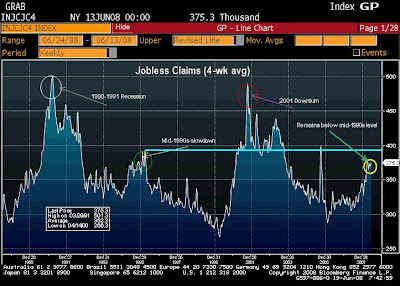
On the economic front, jobless claims for the week ended June 14 declined 5,000 to 381,000. As touched on yesterday, I was looking for this figure to come back to the 375,000, but a decline is good and continuing claims fell to the lowest level in six weeks.

We remain meaningfully below the 400,000 level – hitting 400k would indicate statistically significant monthly job losses – and well below levels of the typical recession/downturn. Notice, as most readers are aware, that we have yet to even hit the mid-1990s slowdown level, which was a period of extremely transitory slowing that saw economic growth bounce back with much force.

Finally, the Philly Fed index – a gauge of factory activity compiled by the Philadelphia Federal Reserve Bank – showed that manufacturing activity continues to weaken. Most regions in fact have shown weaker factory activity over the past few months, but the Philadelphia region has been particularly hard hit as it is more dependent on the housing sector than any other.

Most of the sub-indices were ugly as well, with new orders and shipments moving lower. Unfilled orders and delivery times were also negative, but improved from the May readings.

Importantly, the largest manufacturing region, the Chicago-area – is holding up pretty well as it hovers around the break-even point that divides expansion from contraction. The nation-wide survey looks pretty much the same, as we’ve depicted with graphs over the past few months.

I do believe the sector as a whole will improve and move back to expansion mode sometime in the next couple of months, as business spending and the production necessary to rebuild inventories take hold. That said the regional surveys will likely remain shaky until housing finally bottoms.

Have a great weekend!

Brent Vondera, Senior Analyst

Thursday, June 19, 2008

Daily Insight

U.S. stocks extended upon Tuesday’s losses after FedEx posted quarterly results that were lower than expected and Fifth Third Bancorp cut their dividend by 65% -- a dividend that they had just boosted three months back.

Stocks began the day lower and never looked back. We bounced around in negative territory, looking like some momentum may get the broad market to the plus side, but it failed to materialize and we ended lower by roughly 1%.

The FedEx news showed how higher energy costs – and Fed mistakes, in my view – are having some widespread effects. The company stated that while activity was relatively weak (largely in terms of the higher cost Express Air deliveries), the big issue for the quarter was their inability to keep up with rising energy costs. FedEx does have to deal with a two-three month lag when it comes to increasing fuel surcharges and when crude prices rise so abruptly this reality exacerbates the issue. They also mentioned full-year guidance will be in a range of $4.75-$5.25 per share, well below the estimate of $6.00.

To no surprise, financial shares pushed the broad market lower on the Fifth Third news, but the group was not the worst performer as consumer discretionary shares held that unwanted position. All 10 major S&P 500 industry groups declined.

A number of uncertainties are keeping stocks range-bound, as we’ve mentioned for some time now. Some of these questions are economically endogenous, such as future tax and trade policy, the price of energy and the duration of the housing correction, and some are exogenous, such as geopolitical risks, namely Iran and their terrorist-group proxies.

But we shouldn’t forget that a number of economic indicators remain quite upbeat, while others have shown signs of improving of late.

For instance:

  • Retail sales have rebounded nicely after a few months of lackluster activity. Retail sales ex autos and gas stations receipts (adjusting for the rise in pump price and showing that consumers have the aggregate resources to purchase other items) are up a powerful 10% at an annual rate over the past three months.
  • Business sales remain on an upward trajectory, rising at an 8% annual pace over the past six months. As a result, inventory levels remain very near record lows. The production needed to increase stockpiles will catalyze growth in the back-half of the year, in our view.
  • The labor market is holding up quite well and even though we’ve lost jobs over the past five months, just 4% of the 8 million jobs created during the previous five years have been erased. We’ve lost a net 324,000 payroll jobs since January; during the typical economic downturn we see this amount of losses in one or two months’ time.

In addition, once the Fed gets it right and boosts their benchmark rate to 3.00% by year end – that’s my personal call at least – oil will come off these highs and stocks, the economy and the consumer will receive a substantial boost.

We were without a major economic release yesterday, but get back to it this morning with the weekly jobless claims figure. Recall, last week we saw a boost to the 380,000 level – for new readers we want to get back to 365,000-375,000 for now. Any sign that we are trending toward 400,000 in weekly claims will be troubling. Last week’s jump may have resulted from the issue of seasonally adjusting for the Memorial Day holiday as it pushed the prior week’s data meaningfully lower and hence we got that boost last week – which was actually for the week of June 7. This morning’s data will give us a cleaner look as the adjusting process to that holiday will have passed.

Moving along to energy policy, CNBC had analysts and commentators on all day long yesterday talking about whether or not to open up restricted federal lands along the outer continental shelf, et al., that have proven oil and natural gas reserves. Literally, all day they went round and round as if this is a tough call. For the love of God, just drill.

Ronald Reagan, in his epic 1964 speech “A Time for Choosing” stated: “They say the world is too complex for simple answers. They are wrong. There are no easy answers, but there are simple answers.” He was of course referring to the Cold War.

In this case though, we have the best of both worlds. The answer is both easy and simple, especially with energy prices perched at these lofty levels and regimes that hold vast reserves hell-bent on the destruction of the West. As Daniel Henninger has so forthrightly put it: drill, drill, drill!

And while we’re on the subject, those opposed to increased levels of production have come out with a new claim: energy producers are sitting on 68 million acres of leased land that they are not currently drilling on and thus they should not be allowed to lease additional areas. This has become the new talking point as I heard it verbatim from three different politicians within an hour’s time last night

But let’s inject a few realities:

  • First energy companies must engage in geological/seismic testing to find where the oil – if any – is on a given parcel of land (there are no proven reserves when the leasing process begins regarding many of these areas)
  • Then they must move through the long process of local, state and federal permit approvals – and the lawsuits that pop up from environmental groups which delay work for years in many cases
  • Lastly, this claim that government will take the land back (part of this new “use it or lose it” threat) if production or the processes necessary to get to that stage is not occurring is already law. If nothing is being done, then there is no argument; the oil companies lose that land. But why would they pay the lease if they were not going to do anything with it? Some of these parcels are “dry” and they must move on to another site

Finally, beyond the fact that more production is necessary, we shouldn’t neglect the reality that this new approach will create thousands of high paying manufacturing jobs. We often hear how productivity increases and global competition have reduced U.S. manufacturing positions. Well, this is one way to boost jobs within the sector in a big way.

Have a great day!

Brent Vondera, Senior Analyst

Wednesday, June 18, 2008

Daily Insight

U.S. stocks fell on Tuesday, led by financial shares after a Goldman Sachs analyst predicted banks will have to raise $65 billion in new capital and the economic data of the day was less than inspiring – an appropriate statement for the industrial production number, but a clear understatement regarding May housing starts, which remained ugly. We’ll get to these topics below.

Stock-index futures jumped in pre-market trading and that flowed through to the regular trading session after Goldman Sachs reported much stronger-than-expected quarterly results. However, stocks struggled to hold those gains after that very weak housing starts reading and a second straight monthly decline in industrial production. When that Goldman analyst’s banking sector prediction hit the press about 10am that was all she wrote and the major indices moved into the red and failed to bounce back.

I wouldn’t put too much into the warning that there is still serious credit-related fallout to come, as that GS analyst stated, as the firm is likely short credit derivative indexes and financial-sector stocks. I’m not saying the issue is completely behind us, but just to keep in mind that GS may have reason to encourage these comments. To be fair, their Basel II risk-adjusted Tier 1 ratio was 10.8% which was stronger-than expected and their principal investing activities – specifically via Chinese bank ICBC – also helped results.

Seven of the 10 major S&P 500 industry groups closed lower for the day, led by financial and consumer discretionary shares. To no surprise, energy shares led the gainers as the index that tracks these shares gained 1.7%.

Decliners beat advancers by a two-to-one margin on the NYSE. Some 1.1 billion shares traded on the Big Board, roughly 25% below the three-month daily average.

On the economic front, the Commerce Department reported builders broke ground on the fewest number of houses in 17 years during May signaling residential fixed investment will remain a large drag on the economy.

This is certainly not a great revelation, as it is expected that housing will weigh on GDP for a few quarters still – which has been the case for nine quarter already. The extent of the weakness though shows the degree to which this segment will subtract from GDP will be substantial – extending the trend of lowering real GDP by more than a full percentage point.
Inventories are simply too elevated and until we get the sales figures to kick up, we’re not going to see the inventory-to-sales figure come much lower. As the graph below depicts, new home inventory stands at 10.6 months’ worth of supply. We need this number to come down to 6 months’ worth before housing begins to add to growth once again. My feel is that housing will flatten out by the second quarter of 2009 and will add slightly to growth by the end of 2009.

In a separate report, Commerce also stated industrial production declined for a second-straight month, falling 0.2% in May. The April decline was 0.7% and the trend is not good. It’s important that we see some rebound for June because we do not want one of these sub-zero gaps to occur – illustrated by the chart --, that would spell trouble.

I expect the figure will rebound this month and it is important to note that below average temperatures in May was the main reason for the negative reading.

Utility activity weighed heavily on the reading as it was this industry group that was by far the worst performer, falling 2.7% in May. Capacity utilization fell hard within the utility component, while the other industries were in line with the April reading. Average temperatures were below the historic average, according to the National Climactic Data Center.

Lastly, the Labor Department showed that producer prices jumped 1.4% in May and 7.2% from the year-ago period. This was mostly driven by higher energy prices as the ex-energy reading rose by a much lighter 0.4% in May and is up little more than half as much in terms of the overall reading from the year-ago period.

Hello, Fed – anyone home? This is a dollar problem, wake up and get to some mild rate hiking.

Food prices are also contributing to the rise, and while this is partially a function of a lower dollar and aggressive Fed easing of the past six months weather is also playing a role as heavy rains are keeping farmers from getting into the field and planting. What they can do is diminish the energy-related issues, and if food costs come lower too, then that’s an additional plus.

And speaking of the Fed, those WSJ, FT and Wash Post articles we referred to in yesterday’s letter also contributed to Tuesday’s market weakness. These articles suggested that the Fed is not going to raise rates and focused on the point that higher rates erode profits, specifically within industries that rely on short-term financing.

Well excuse me, harmful levels of inflation destroy profit growth for nearly all industries as margins are compressed due to escalating costs. Thankfully, for now, firms have shown an amazing ability to eat these costs and still post good profit results as productivity improvements remain strong. But this cannot go on forever, as the current level of energy prices will eventually erode this ability to manage these rising costs.

Besides, we’re not talking about 6% fed funds, but just getting us back to 3.00% from the current target of 2.00%. This is hardly anti-growth and in fact will boost profits and GDP as the dollar strengthens, oil comes lower as a result and beneficial profit margins remain intact.

We’ll also make this point: As the Fed dithers inflation will accelerate and they will find themselves in a situation where they’ll be forced to jack rates higher next year to a level that will be destructive to growth. There is still time to get it right and I believe they will begin their rate-hiking campaign at the August meeting on their way to 3.00% fed funds by year end. Again, my belief is that this will be a huge positive for the market, the dollar and oil. But Bernanke and Co. need to gets their heads out of their textbooks -- nothing there will direct them in the proper direction -- and pay more attention to market trends, specifically the dollar/oil link.

Have a great day!

Brent Vondera, Senior Analyst

Tuesday, June 17, 2008

Daily Insight

U.S. stocks bounced around as offsetting economic reports and a fairly dramatic turnaround in crude prices left traders unsure of the position to take during the session.

Stocks began the day lower as oil per barrel shot up $5, coming just 20 cents shy of the $140 mark and the two economic releases of the day canceled one another out – New York-area manufacturing posted a weak reading, but foreign security purchases show there is plenty of appetite for U.S. securities. But energy traders, after brushing off the Saudi announcement to increase production by 550,000 (formerly 300,000, boosting that by 250,000 this weekend) per day beginning next month, shifted their positions. As a result, crude dropped $6 and stocks rebounded to the highs of the day before closing flat. The chart below illustrates the day’s activity.

Of the 10 major S&P 500 industry groups, financials were the best-performing area, adding 1.05%. Energy and information technology shares also gained some ground, while consumer staple and health-care shares led the laggards lower. By the close, six of the 10 ended in the red.

On the economic front, the Empire Manufacturing survey showed New York-area factory activity contracted in June – this marked the second-straight month of decline and the fourth in the past five. Fortunately, the New York region is not a terribly significant portion of total U.S. factory activity, as one might expect. The national reading is hovering right at the expansion/contraction mark of 50 and has shown mild improvement over the past couple of months.

But regarding the Empire number, clearly financial-sector woes are hurting activity in the region. Businesses have to contend with both higher costs and increased layoffs/smaller bonuses at the large brokerage firms. This doesn’t affect manufacturing in a direct sense, but does flow through to orders as the weakness trickles down.

A couple of the key sub-indices within the report were ugly as new orders came in at -5.5, shipments posted a -6.5 reading and unfilled orders posted -10.5 – all lower from the previous month. On the bright side, the index that measures the outlook for the next six months jumped to the highest level this year, coming in at 32.3 from 23.9 in May and 19.5 in April.

Note, on the Empire Index, a number above zero marks expansion; the national factory index – the ISM reading we talk about each month – marks expansion by anything above 50.

In other news, the Treasury Department reported that foreign security purchases jumped $115 billion in April – there’s a pretty large lag to this data as it takes times to compile. We’ve heard a lot about how the trade deficits are the reason for the falling dollar, but the value of the greenback in actually driven more by Fed policy than anything else, especially in the relative short term.

If perhaps, most of the dollars foreigners held via trade were converted into other currencies to buy assets outside of the U.S. then, yes, trade deficits would lead the dollar lower. However, so long as these governments and investors return most of these dollars to the U.S. via security purchases then the old Keynesian argument doesn’t hold up. For instance, the U.S. trade gap over the past 12 months has run about $692 billion, while foreign security purchases over this period have registered $772 billion. The trend is true for the past few years.

Moving along to the Fed, it appears the press – the WSJ, FT and Washington Post – are attempting to walk the market down from their fed funds expectations. Fed funds futures were showing a pretty good indication that the FOMC would begin to gently raise rates by the August meeting – holding steady at next week’s get together. But some comments from Richmond Fed President Lacker seem to have confused some people. He did mention that the Fed may hold pat, but I believe he was referring to the June 25 meeting. He also raised serious concerns regarding inflation and it seemed fairly clear to me he was signaling a hike in August. The press saw it differently, and the possibility of the FOMC holding off for an indefinite period led the headlines last night.

As a result, expectations of some tightening have come off a bit. The bar chart shows expectations for the June 25 meeting, and no change in policy is largely expected. But notice how things have changed from the “1 day ago” reading, as shown in the table (top table to the left). And importantly, notice how expectations for a hike in August have come off (second table). There was a 68.5% chance of at least a 25 basis point hike in August yesterday. Today that expectation has dropped to 56.5%.

I think the view regarding some tightening will increase again this morning after the producer price index for May is releases at 7:30CDT. This number is trending 6-7% year-over-year and unless it returns to the 4-5% range, the Fed will feel pressure to do something – at least I hope they will for the dollar’s sake and the price of oil.

Have a great day!

Brent Vondera, Senior Analyst

Monday, June 16, 2008

Daily Insight

U.S. stocks gained some nice ground Friday, as oil decline a bit and the latest consumer-level inflation report posted a number that was pretty much in line with the officially stated expectations. While the core rate remains remarkably tame in the face of higher food and energy prices, to have the headline number pushing above 4% is not great news but I think there was a whisper number expecting something worse. As a result, the market found reason to rally.

Consumer discretionary shares led the advance as oil prices declined and investors pushed these shares higher after Thursday’s very good retail sales report. The group didn’t gain much ground in the previous session even though that May retail report justified a nice move higher; what we saw on Friday was likely some flow through there.

Energy, basic material, financial and technology shares also performed very well. All 10 major S&P 500 industry groups ended the session higher.

Oil prices declined on Friday, not by a lot but we’ll take what we can get for now. We have received some nice comments from G7 members this weekend as their main focus was commodity prices. So long as the group focuses on rising energy and food prices as their major concern regarding future economic growth I think we may see a lid put on oil prices as the dollar will get some support. In the end, either the Fed will have to begin to gently raise rates, the G7 will have to back their words up with action of intervention, or a combination of the two before the dollar can get back to 80 on the Dollar Index (currently it stands at 73.75 – the 80-85 range is the optimal dollar level in my view) and oil goes meaningfully lower. We need to see the G7 take charge here for once. While the dollar has stabilized of late, it would be very harmful for both the U.S. and global growth if the greenback were to test the 70 handle again as it did in mid March.

The dollar posted its biggest weekly climb since 2005 as more expect the Fed will need to tighten policy a bit and on those G7 comments. I should note that the group meeting these days is actually the G8, but I choose to go by the G7 still as Russia, the latest entrant, is nothing but a thorn in everyone’s side and brings virtually nothing to the table – nothing productive at least.

This weekend we also saw that Saudi Arabia has chosen to boost production by 550,000 barrels per day beginning next month. This will bring their daily production to roughly 10 million barrels. It appears that Bush trip a couple of weeks back actually was effective – it was reported at the time that he went hat-in-hand to the Saudi’s and came back with nothing. I don’t think it is a coincidence that they are suddenly announcing a boost to production as the President likely reminded the Saudi Family it is the U.S. that stands between them and an Iranian regime that would love to invade as Mideast hegemony is their primary goal.

Another key factor is also that OPEC fears the fact that crude prices have remained at these lofty levels. They know if crude in the $130 range is sustained for a meaningful period of time that alternatives will eventually account for a larger percentage of our sources of energy. As they see it, better for them to lower the price a bit via higher production then allow alternatives to bring prices crashing lower.

This is one reason why many of the alternatives that are looked upon as the panacea for our energy issues are simply difficult to bring to market in a cost effective way. This is not the way the world is currently set up. For alternatives such as solar, geothermal and coal-to-gas, we need the current price of oil to remain at these levels or the capital simply won’t be there to bring it to market in a way that significantly lowers the price. Fact is fossil fuels are still the cheapest source. The really unfortunate thing is that we could break the back of OPEC if we only had the will to drill for all known reserves within our own land and engaged in a policy to power the “grid” solely with nuclear and coal. This would bring crude and natural gas prices much lower, and these are the sources with which OPEC currently provides roughly 40% of world supply.

On the economic front, the Labor Department reported the May CPI (consumer price index) reading came in at 4.2% from the year-ago period – CPI has been hovering around 4% since December. For the month, the reading showed no sign of abating, rising 0.6% in May alone. The core rate, which excludes food and energy, does remain tame, rising just 0.2% in May and 2.3% from the year-ago period.

I’ll note, when we average all three major inflation gauges overall inflation is running at 3.5%.

The Fed continues to focus on the core reading. We have argued they need to drop this look and focus only on the headline figure as food and energy prices are the real issue. The significance of the core rate is that it shows high energy prices are not fully flowing through to the costs of other items. We can thank strong productivity improvements for this, but the Fed ought not expect either energy prices to come lower simply because growth is weak or that these higher energy prices do not cause other problems. Firms are eating these higher costs and this could hurt profit growth down the road. A little rate-hiking could go a long way, and outside of the conventional wisdom may just be quite positive for both economic and profit growth.

As the whole point of this morning’s commentary suggests, higher energy prices were the driver of the CPI report. The energy component jumped 4.4% in May as gas and electricity was up 2.3% and gasoline up 5.7%.

On the optimistic side of things, medical care costs have really stabilized rising just 0.1% each month since February, which is nice. Most of the other components don’t look bad either; it’s just the energy side of things and some food prices. Fed can take care of this energy move, just do it.

Have a great day!

Brent Vondera, Senior Analyst