Visit us at our new home!

For new daily content, visit us at our new blog: http://www.acrinv.com/blog/

Friday, August 15, 2008

Daily Insight

U.S. stocks gained ground Thursday despite a rough day on the economic front – and guess which sectors led the way? Yep, financials and consumer discretionary shares as has become the trend on days of strength. As we touched on yesterday, one can look at these two areas and based on their direction you pretty much know whether or not the benchmark indices advanced.

Ugly economic releases from the Labor Department sent the broad market lower at the open, but stocks quickly reversed course gaining nearly 2% from the session’s low – holding onto most of that rally to the close.

Market Activity for August 14, 2008
As financials (up 2.55%) and consumer discretionary (up 1.97%) led the way, most industries participated in the rally as seven of the 10 major S&P 500 groups rose. Information technology and industrial shares gained 0.70% and 0.56%, respectively. Consumer staples, health-care and telecom stocks advanced a bit as well.

The dollar continues to catch fire as evidenced by the Dollar Index, which has moved to the 77 handle. The greenback has jumped 7.30% in the past month – a huge move.


However, the 80 level in probably necessary to escape what many perceive as troublesome levels. I believe we need to see some mild Fed tightening in order to get there, but most seem to disagree with this view due to the credit/financial-sector woes. We shall see where the inflation gauges take us – more on this below.

In any event, it is good to see the greenback rally and it’s helping to push commodity prices lower from the highly pernicious move that took place in the three months ending June.


On the economic front, the Labor Department reported that initial jobless claims dropped 10,000 to 450,000 in the week ended August 9. While a decline is nice, the figure currently hangs at a worrisome range. The chart below shows the four-week average has jumped well above the 400k level – this does not bode well for the August jobs report. As we had discussed for several months, jobless benefit claims held below this 400k level, which gave us confidence the monthly job losses would remain mild. Now that this figure has spiked, it becomes much more difficult top remain sanguine that those losses will remain below 80,000 per month.

That said, due to the government’s Emergency Unemployment Compensation Program it will take a couple of weeks to get a truer reading on claims as a way to gauge the overall job market. (The BLS (Bureau of Labor Statistics) believes the impact of this program has peaked.)

Thirty-five states and territories reported an increase in claims, while 18 reported a decrease.

Continuing claims – those collecting benefits for more than a week – have risen to the highest level since October 2003. The recent government program to extend the length of time one can collect is helping to push this figure higher as those that would otherwise have seen benefits expire, can continue to take the handout.


In a separate report, the Labor Department reported the consumer price index rose 0.8% in July and accelerated on a year-over-year basis to 5.6% -- that’s the highest in nearly 18 years. On a three-month annualized basis the CPI has jumped 10.6%; that’s an acceleration from 7.9% during the previous three-month set.

I’ll note CPI is known to overstate inflation, yet the chained CPI figure – which tracks consumer preferences and the substitution effect more quickly – rose to 4.8% year-over-year after a readings of 4.2% in June and 3.6% in May. This means the Fed’s preferred inflation gauge, the PCE index – will hit roughly that level, which is considerably higher than Bernanke’s stated “comfort zone.”


Over the past few weeks we’ve mentioned the risk of inflation becoming embedded – that is, firms have gotten hammered with higher commodity costs for such a long time they have now begun to aggressively raise prices to compensate for those higher costs. The ISM and PMI (as most readers know these are factory activity indexes) business surveys have been showing this occurring of late; now we have the most-watched small business survey (from the National Federation of Independent Business – NFIB) report a record-high percentage of firms both raising prices and planning to do so in their latest August report.

People look at the lower energy prices of late and expect this to push future inflation gauges lower. I’m just not sure this will occur to the extent they are expecting due to the trends just mentioned. In addition, food prices are also boosting the inflation figures, so energy isn’t the sole reason. On the bright side, the medical care reading within CPI has been nicely contained over the past several weeks and decelerating -- up just 0.1% in July.

There is one group that can essentially make sure the inflation trend does moderate and that is the Fed. Just some mild tightening could go a long way. Yes, this will hurt mortgage resets, but many of these people are in a world of hurt anyway – fed funds could be cut to 1.00% and those that couldn’t afford the initial interest rate on their adjustable mortgage will still find they’re in a bad spot. Besides, those that put little-to-no money down now find their loans are higher than the house is worth. And further, yes, banks need to raise capital and the Fed’s easy policy has this in mind also. But it is a very dangerous game to abandon price stability. Besides, let’s not put undue harm on the entire economy just to help out those that have made poor decisions.

In other news, I see the Europeans have been mugged by reality as the Russians continue to push into the interior of Georgia, well past Ossetia. The Germans had been blocking Eastern European membership to NATO. Now that it has become obvious Russia’s aim is to control the Baku-Tbilisi-Ceyhan pipeline – the only oil flow in the region that Russian does not have control over – and thus block energy to Western Europe, while attempting to dictate Eastern Europe’s future, the Euros seem to be coming around. This is an important and very positive development even if Russia’s actions are troubling.

Have a great weekend!


Brent Vondera, Senior Analyst

Thursday, August 14, 2008

Daily Insight

U.S. benchmark indices declined for a second day – led by what else? financial and consumer discretionary shares. These have been the stocks that either push the major bourses higher during rallies or pressure the benchmarks on days of decline as questions over the housing market and consumer are the lead worries. (For the market in total, certainly inflation, tax rate, dollar/oil and geopolitical event uncertainties all currently weigh on investor sentiment. But regarding GDP components, it is housing and the consumer and so long as this is the case financials and consumer discretionary will determine the market’s direction.

The broad market did improve as the day wore on (as the chart below illustrates) thanks to core retail sales growth and business inventories and sales data that indicate the economy is not as weak as many portray. A higher revision to GDP has been our theme for a couple of days now as that’s what the data of the past few days is telling us. The mid and small-cap stock indices bucked the trend to advance yesterday.


Market Activity for August 13, 2008

The best performers of the day were energy, basic material, utility and information technology shares. Energy stocks received a boost, after four-straight sessions of decline, as oil rose 2.65% to $116 per barrel. The weekly energy report showed a larger-than-expected decline in supplies – which was probably a result of Tropical Storm Edouard as it caused rigs to suspend production and halted imports for a couple of days.

On the economic front, overall July retail sales fell for the first time in five months due to weak auto sales – the figure declined 0.1%. Excluding autos, sales rose 0.4% last month and have jumped 10.3% at an annual rate the past three months.

Core retail sales, which exclude autos, gas station receipts and building materials, rose 0.3% in July and are up 10.2% annualized the past three months.

The relevance of this core reading is two-fold:

One looking at this figure minus gas station receipts during a time of high prices helps to reduce the impact of a boost in this figure due to those high prices. Further, subtracting building materials has helped to smooth the data and remove the volatility of a housing market that was boosting the reading to robust levels during the peak of the housing boom that ran 2005-2006 and subtracts from the figure due to the housing correction currently.

Second, this core retail figure is used to calculate the consumer spending portion of GDP – since this reading has advanced at a pace that outpaced inflation during the quarter (thus real consumer consumption was higher) it provides yet another indication Q2 GDP will be revised higher.

In a separate report, the Labor Department reported that import prices jumped 1.7% in July and has accelerated to 21.6% year-over-year. Even excluding oil the figure remains high, up 0.9% in July and 8% from this time last year. The dollar/oil trend of the past few weeks will help to improve this, but we’ll need to see oil and the greenback continue to trend in the desired direction or at least hold here.


Lastly, the Commerce Department released its June business sales and inventory reading. This figure also illustrates GDP will be revised higher. Putting the trade (as discussed yesterday), business inventories and core retail sales data together – all figures that were stronger than initially estimated when the first look at GDP was released – we’re looking at a real rate of growth of at least 2.5% and may be close to 2.8%. That’s not bad considering housing’s drag on the economy. (For context, our long-term average is real annual growth of 3.4%, or roughly 6.5% in nominal terms.)

Anyway, business inventories rose 0.7% in June, beating the expectation of a 0.5% increase. Sales growth was powerful again, jumping 1.7% in June -- up 17% annualized past three months and up 9.2% year-over-year.

I’ll caution, since we’ve had four straight months of robust sales data (up 1.2% in March, 1.5% in April, 1.1% in May and now this big 1.7% increase), July will probably show a natural decline. The economy is weaker-than-normal and this pace will not be sustained. Nothing wrong with that, I’m just preparing everyone for the media hysteria that arises when the number posts a decline as these people are unwilling to put things into perspective.


This morning we get the CPI figure for July and initial jobless claims. Both will be closely watched, but the market will probably focus a bit more on the jobless claims number since it has moved higher over the past two weeks and is showing an ugly trend. The CPI reading looks ugly too but the recent decline in energy prices has eased the inflation worry a bit – for most at least.

Have a great day!


Brent Vondera, Senior Analyst

Wednesday, August 13, 2008

Daily Insight

U.S. benchmark stock indices declined yesterday, pushed lower by financials shares after JP Morgan warned it may post more credit losses – not sure this was really news as most expect financial losses to drag on for at least another quarter, but there just wasn’t much else to trade on so the market focuses on this negative.

Also putting pressure on bank stocks were comments from Dallas Fed Bank President Richard Fischer who mentioned the current financial turmoil is worse than the savings and loan crisis of the late 1980s/early 1990s. I’m not sure about that one, especially since William Seidman (former chairman of the Resolution Trust Corporation, which was instrumental in cleaning up that mess) has gone on record saying the two are not comparable. But, we shall see. For now, not surprisingly, these types of comments will be met with market downside.

Market Activity for August 12, 2008

As said, financials led things lower as the S&P 500 Financial Index lost 5.19%. Utility and consumer discretionary shares were the other major losers down 2.08% and 1.48%, respectively.

Consumer staples and basic materials were the only two major industry groups to post gains. Commodity prices fell some more yesterday but the declines leveled off, offering some support to the materials stocks – these shares have taken a beating over the past few weeks. The CRB (Commodity Research Bureau) Index has dropped 18.8% from the July 2 high.


On the greenback, the dollar continues to strengthen, which is nice and is a development that was very much needed regarding international-investor perceptions and inflation – particularly with regard to import prices. As we touched on yesterday, I think we’ll need a little Fed tightening to get us to 80 on the Dollar Index – a level that will make those worried about the greenback much more comfortable. For now though, at least we’ve returned to where we were in February and have erased the most recent leg lower.


On the economic data front yesterday, the Commerce Department reported the trade deficit narrowed in June, which was an unexpected move as the estimate was for the figure to widen – although I’m not sure why the narrowing was a surprise as import activity has been lagging export growth for many months now. Nothing of late has shown this trend will end in the immediate future.

Exports rose 4% as imports were up 1.8%. The importance of this narrowing is it will result in a higher revision to second-quarter GDP (the initial estimate to Q2 growth assumed the deficit widened in June). Combine this fact with higher inventory and capital expenditure (capex) figures and we may just see that 2.6%-3.0% real GDP reading we expected a couple of weeks back.

But back to the trade figures for a moment, in real terms (adjusting for inflation) the trade gap narrowed sharply (to its lowest level since December 2001) as real imports declined 0.6%.

U.S. exports have been on fire fueled by sales to South America and OPEC countries. Exports to OPEC countries has jumped 33.7% on a year-over-year basis. I mention this to point out the fact that higher oil prices are not a zero sum game as this flows back in higher export activity.

These comments have in mind all of those that speak of importing oil as a wealth transfer – as if these funds are lost forever. Those that speak of wealth transfers due to trade fail to tell the entire story and are often times either oblivious to how the global economy works or intellectually dishonest. A large degree of the U.S. dollars that move overseas in exchange for goods come back to us in the form of investment. (Before I go on, make no mistake – I do not enjoy being more dependent than needs to be the case on certain regions of the globe for our energy needs. In my world, congressionally built barriers to domestic energy production would be torn down never to be rebuilt. In the end we will accomplish this simply because we’ll have to. The state of the world will marginalize those that believe producing our own abundant sources of energy is a bad thing – a mindboggling stance.

But back to the flow of capital, a large part of it comes back in the form of investment. Some goes to the Treasury market, simply because this is the most liquid and broad market in the world. A significant degree of it though also goes to corporate bonds, equities, mortgage-backed securities, and venture capital. I’ll remind everyone that our long-run return on capital is higher than our cost of capital. Hence, those funds finance future growth, which creates jobs, provides the seed money for innovation and technological advances and leads to higher levels of income growth -- higher levels of productivity, improved living standards, lower inflation and real economic growth are the by-products.

In other news, the Treasury Department reported the July budget deficit widened due to the rebate checks and increased outlays to the FDIC to cover insured deposits at failed backs. The $102.8 billion deficit last month compared to the $36.4 billion in July 2007. Lower tax revenues due to job losses and lower corporate profits – mostly a result of financial-sector woes – has also increased the deficit, but the real damage has come from this Keynesian rebate check scheme.

Too bad because last year we had whittled the budget gap down to just 1.2% of GDP – half the long-term average. This year will be a different story, however. Nevertheless, the deficit will remain manageable for now, but if we do not get a handle on entitlement spending and reform these programs to reflect changing demographics we’ll have a problem on our hands a few years forward.

On the bright side, corporate tax receipts rose 6.6% in July on a year-over-year basis. This marks the first increase in a year.

This morning we get some very important data as July import prices and retail sales will be market movers. Also we get the June business inventories report, which should show the estimated inventory change that dragged so heavily on GDP was flawed. A larger-than-expected reading here will provide additional evidence Q2 GDP will be revised h

Have a great day!


Brent Vondera, Senior Analyst

Tuesday, August 12, 2008

Daily Insight

U.S. stocks gained for a second-straight day – up four of the past five sessions – as oil has dropped to a 14-week low, boosting shares in most major industry groups. Consumer discretionary and financial shares led yesterday’s increase. Energy and material shares were the only decliners among the S&P 500’s 10 industry groups. The S&P 500 Energy Index has dropped 20% from its May 20 all-time high.

What has occurred in oil and the dollar since I’ve been out has been pretty amazing and welcome. I’m contemplating taking about six months off – at this pace oil would be down to $10 per barrel, the Dollar Index would hit 100 and even stocks would be higher by 10%. Although at this rate, six months from now Russia would have regained control of the Caucuses and all of Eastern Europe.

Market Activity for August 11, 2008
The decline in oil prices has been very welcome, as we’ll touch on more specifically below. It’s almost hilarious to watch this stuff as the press and energy-industry analysts now talk in terms that make one feel there are no risks that can push prices higher again. For instance, the IEA – International Energy Agency – is now saying that supply will be more than sufficient to meet demand; this is with an increase in their 2009 demand forecast. This is the opposite of what we have heard over the past several weeks as these agencies were stating supply was inadequate. And oil continues to move lower even with the Russia/Georgia conflict and the uncertainties this brings regarding the Caspian pipeline.

Over the past eight trading sessions market activity has continued along its whipsaw path. The first three days of my absence the broad market was down 2.76%; it more than erased those losses jumping 3.21% last Tuesday and Wednesday; gave much of that back on Thursday, but following Friday’s big day, helped by yesterday’s rise has put us up 1.6% since the July 30 close.


We were without an economic release yesterday, so I thought it may be helpful to touch on the economic highlights since I’ve been out. David likely touched on many of these points already, but it is worth reviewing this stuff.

Second Quarter GDP

The economy grew at a 1.9% real annual rate.

The additions to growth were:
Personal consumption (although it added less than what I was looking for as higher inflation reduced real consumption. CPI rose at a 7.4% annual pace in the second quarter.)

Exports provided a large boost, but the degree to which it helped was not from export activity alone but net exports, which jumped due to a decline in real imports – import prices have soared, reaching 20% year-over-year as of the latest data.

The drags on GDP were:

Housing subtracted from growth for the 10th straight quarter, but the decline was much less than it has been averaging. Residential fixed investment declined at a 15% annual rate March-June, much less than the 27% annual rate of the previous quarter. Maybe a portent of good things to come; we shall see.

The change in inventories weighed heavily on the figure. Although, if something is going to weigh on growth, let it be this. Stockpiles are very low and firms will have to increase production, which will keep growth positive in the coming quarters. Friday’s wholesale inventories figure continues to illustrate this fact. Sales continue to rise, jumping 2.8% in June driving the inventory-to-sales ratio to an all-time low.

July Jobs

The labor market remains weak as July marked the seventh month of decline. However, the level of losses remains relatively low compared to normal job-market downturns. Construction and business services continue to weigh on the figure; education and health-care continue to be the bright spots. Youth unemployment also continues to drag the figure lower.

June Factory Orders

This was the best release of the past week-and-a-half. The figure jumped 1.7% for the month and continues to indicate good business spending trends are upon us.
New orders were up for the fourth-straight month; shipments up six months straight (up 1.6% in June to $454.6 billion, the highest since the series began in 1992.)
Unfilled orders up for 28 of the past 29 months to the highest level since the series began.

Non-defense capital spending (a proxy for business spending) was up a strong 1.2% in June. I’ve got to think GDP will be revised higher due to the combination of this data and the June inventory number (which was higher than estimated) -- the May figure was revised higher as well.

The biggest news of all of the past several trading days was undoubtedly the Fed statement and what oil and the dollar have done.

First the Fed

What is going on appears to be an attempt at a “garrulous” form of tightening. That is they are talking tough, but doing nothing even as the inflation gauges rage past the FOMC’s desired levels and they even admit the state of inflation is “highly uncertain.”

The FOMC (for new readers that may not know, this is the committee that determines policy) statement can always be summed up in three paragraphs: Growth, Inflation and Future Stance. The Fed continues to worry about economic growth and credit-market functioning, but has become quite worried about inflation too. Problem is when the FOMC states that inflation is “highly uncertain,” yet they do not raise rates – even mildly – it becomes worrisome. That term “highly uncertain” may be signaling a slight increase in rates quicker than most seem to expect, I may be alone on this thought.

(Look, I realize that it doesn’t make sense to jack rates higher due to credit-market and financial institution issues, but those talking about such action desire a gentle increase. The longer they wait, as inflation becomes embedded, the greater the likelihood they will have to jack rates up to a point that does major economic damage. And there is evidence that price increases are becoming embedded, as the most watched small-business survey along with the ISM and PMI indices show this is occurring.)

Again, as we’ve discussed many times, the Fed does not have a magic wand. There is not much they can do about housing – only time can reverse the excesses of 2005-2006. But they can determine the direction of inflation and it is problematic that they have abandoned price stability as we have been left with both the housing correction and higher levels of inflation.

Now on oil and the dollar

What has occurred here has been huge and is giving Bernanke & Co. some cover -- not that they needed it though, they didn’t seem too eager to quash inflation as oil jumped to $145 per barrel and the dollar was in the dirt, down to 71 on the Dollar Index. In fact, I think they could have pushed oil down to $100 with a 25 basis point cut – hammer it when it’s down.

For now though crude has come down on some very good comments out of Congress – pushed by President Bush – leading the market to believe just maybe drilling restrictions will be removed. This has combined with a reduction in government subsidies in Asian economies (subsidies that have kept demand higher than it otherwise would have been at these price levels.)

It’s tough to read on the chart, but oil is down 7.5% since July 30. Crude has plummeted 22% from the all-time closing high of $145.29 hit on July 3.


On the dollar, I continue to believe it will take some Fed tightening to get us back to 80 on the Dollar Index (a level that is necessary to get us out of the danger zone regarding the greenback) but things have certainly moved in the right direction.


Some of this move has been due to the realization that the Eurozone is weakening and thus a super-strong euro makes zero sense – so traders have moved back to the dollar.

For now though the oil/greenback move is huge. The higher dollar will help ease pernicious import price trends and oil now down 22% from its high will benefit the consumer, GDP, stocks, real income growth and the inflation gauges to some extent if this holds. Huge development.

Have a great day!

Brent Vondera, Senior Analyst

Monday, August 11, 2008

Daily Insight

The roller-coaster ride continued with the Dow posting its second 300-point move of the week and the sixth move of at least 200 points in the last 10 trading days. Meanwhile the S&P 500 jumped 30.25 points higher to finish the week 2.9 percent higher.

Oil futures slid 4 percent to a three-month low of $115.20 a barrel due to expectations of curbing demand and a sharp rebound in the dollar. After tumbling 7.9 percent this week, oil is nearly 21 percent off its early-July highs.

Retailers, manufacturers and transportation companies rallied the most on speculation lower commodity prices will boost profits by reducing pressure on consumer and corporate expenses.

Market Activity for August 8, 2008

Coinciding with tumbling oil prices was a surging dollar that enjoyed its best one-day performance in more than six years. However, the dollar’s rise against the euro may have less to do with the currency’s fundamental strength than the growing feeling that the European Central Bank will focus their attention to the downside risks to growth.

The dollar was also helped by news that worker productivity in the U.S. grew in the second quarter giving investors (and the Fed) positive encouragement on the inflation front.

While three-quarters of S&P 500 companies have reported results that beat or met the average analyst estimates, the misses have been larger in size, chiefly at automobile companies and consumer finance companies. Despite being the worst performing of the S&P 500’s 10 industries, financial and consumer discretionary stocks have led the market’s rebound since July 15 gaining 25 percent and 13 percent, respectively.

There are a number of things to watch this week to see if we can continue this rally.

  • Economic data on retail sales as well as earnings this week from retailers like Walmart, J.C. Penny, Kohl’s and Nordstrom should give us an idea of how the good ole U.S. consumer is doing.

  • Wednesday we will get the MBA Mortgage Applications number as well as guidance from homebuilder Toll Brothers, which will give us insight into the housing environment.

  • One of the most important numbers this week for the Fed will be the Consumer Price Index (CPI), which surged last month signaling the downside risks of inflation may outweigh the downside risks to growth.

  • Other economic news to keep an eye on includes import prices, industrial production and jobless claims.

Brent will be back tomorrow to grace you with his words of wisdom once again.


Have a great day!

Peter Lazaroff, Junior Analyst

Friday, August 8, 2008

Daily Insight

Remember how yesterday, I said that I liked it when the market didn’t lose everything after a big gain like Tuesday’s?

Well, we didn’t quite lose it all, but markets traded lower yesterday to the tune of 224.64 points on the Dow Jones Industrial Average, to close 1.90 percent lower at 11,431.43. A much worse than forecast loss at American International Group (ticker symbol: AIG) was to blame as insurer announced that it lost $5.36 billion on mortgage-related write-downs; shares lost 18 percent of their value.

Oil took an opposite turn, gaining $1.44 per barrel to close up 1.20 percent and close at $120.02 per barrel in New York. It’s too bad, too, since I just filled my tank up today and was thinking how nice it was to be below $60 for a fill-up.

Recently, I read an economist’s take one why we pay such close attention to gas prices: we stand there with nothing to do and stare at the price. Yogurt prices have risen by the same percentage as gasoline prices over the past 18 months, but there isn’t a whole lot of uproar about it (then again, America isn’t addicted to yogurt in quite the same way).

Market Activity for August 7, 2008
This morning futures are basically flat as results from Fannie Mae (ticker symbol: FNM) are reviewed and traders consider oil futures, which are lower again this morning. Right now, oil futures are lower by $2 per barrel suggesting a barrel will trade for under $118 per barrel this morning.

This is no doubt partly a response to the sharply higher dollar, which has moved because China said that it would tighten their currency controls further (is that possible?) and it appears that the European Central Bank will not raise interest rates further. The ECB’s most recent action was to do nothing since it appears that all of Europe is on the verge of a recession/slowdown as well.

As Brent has said many times, at the point when the U.S. dollar stabilizes and begins to recover, the commodity bubble will shrink rapidly (something we have seen in July and August).

With respect to the FNM news, losses were expected and Freddie Mac had already laid the groundwork for some bad results when they posted earnings earlier this week. Therefore, it isn’t likely to have such a negative effect on trading today despite the weak results.

FNM posted a $2.3 billion loss compared to a $1.95 billion positive net income a year ago this quarter. FNM also booked $5.35 billion in credit costs by increasing loss provisions and charge-offs. They also cut their dividend by 86 percent to five cents per share that will save the company $1.9 billion through the end of 2009.

In my personal view, they should have scrapped the dividend on the common stock altogether. I don’t think it makes a whole lot of sense to continue to pay the common shareholder while the government is now officially standing by to rescue the company if they can’t raise enough money to continue independently. Certainly the stocks are so far off (another 11 percent this morning for FNM in pre-market trading) that cutting the dividend to zero wouldn’t likely kill the company. I don’t think anyone still holding the stock is in it for the dividend.

In economic news, U.S. productivity (defined as output per unit of labor) remained strong in the second quarter despite the slowing economy. Non-farm business productivity rose at an annual rate of 2.2 percent in the second quarter. Additionally, labor costs gained only 1.3 percent, below expectations.

This is an important piece of data because labor costs are the largest input in the creation of goods and services. The smaller than expected labor costs suggest that we are not in a 1970’s rerun where higher energy prices spiral into higher labor costs which spiral truly out of control.

Have a great weekend!

Dave Ott, General Partner

Thursday, August 7, 2008

Daily Insight

Yesterday the kind of day that I really like: anytime you have a huge up market day like Tuesday, you really expect to give back at least half of it the very next day, so when that doesn’t happen, it feels like a gift.

Despite the far worse than expected $821 million loss for Freddie Mac (plus some write-downs in the billion dollar range), the Dow Jones Industrial Average rose 40.30 points, or 0.35 percent, to close at 11,656.07. The real stock market winner of the day was the Nasdaq, which gained 1.21 percent after Cisco Systems, Inc (ticker symbol: CSCO) announced stronger sales and net income.

Additionally, oil was lower for the third day in a row as inventory data showed that U.S. consumers are changing their driving habits in response to higher prices (kind of like what you would might remember from Econ 101: prices go higher and demand fall leading to lower prices). At the low point, oil had fallen to $117.11 per barrel.

Market Activity for August 6, 2008

At Acropolis, we have had the view that oil was overpriced. That’s the good news. The bad news is that we started saying it before it had crossed $80 per barrel so we’re still way above what we think it ought to be.

Having said that, however, oil has had such a precipitous drop just in the month of July that it does lead one to believe that oil prices are clearly not operating on fundamental factors alone.

Although the U.S. is consuming less crude, Saudi Arabia has increased their deliveries and demand growth in India and China hasn’t changed in the last 30 days. The obvious change was in trader sentiment. It is widely believed that one of the largest trades among Wall Street hedge funds is “long oil and short financials.”

This strategy was no doubt a winner for most of the year – energy prices are still high compared to Jan. 1 and financials have obviously been a disaster. However, in July, when Wells Fargo came out with better than expected earnings and increased their dividend, the trade turned upside-down as financials had a 50 percent rally from their lows, which undoubtedly forced a lot of short covering and unwinding long positions in energy.

This morning, futures are pointing lower this morning as the insurer American International Group (ticker symbol: AIG) posted a worse than expected $5.36 billion loss on even more mortgage related write-downs.

This is the third consecutive multi-billion dollar loss for the insurer related to mortgage investments. Obviously this kind of write-down, along with the news from Freddie Mac yesterday is enough to keep everyone on edge with respect to the bottom in housing.

In similar news, mortgages issues in the first part of 2007 are already going bad a much faster pace than mortgages issued in 2006. The data goes through April 30 of last year and shows that 0.91 percent of prime mortgages from those four months are seriously delinquent after 12 months, which means that they are either in foreclosure or 90 days past due. The data from 2006 shows that 0.33 percent were in serious delinquency.

The only good news on that data is that the lending really did tighten up by the end of the year, so there is some sense that there could be an end point to the lax lending standards.

In semi-related news, July same-store sales fell short of expectations for the second straight month, but discounters like Wal-Mart continued to pick up the slack. Again, this seems like Econ 101 – in tight times, it seems obvious that consumers would forgo $50 jeans at The Gap and buy $15 jeans at Wal-Mart (disclosure: I have no idea what jeans cost at either store, but you get the idea).

Initial jobless claims just came in higher than expected at 455,000. We will get into more specifics of the jobs number tomorrow, but it looks like we may give back some of the gains made in the last two days.

Have a great day!

Dave Ott, General Partner

Wednesday, August 6, 2008

Daily Insight

As expected, the Fed didn’t adjust their policy interest rates and the market loved it.

The Dow Jones Industrial Average closed 331.62 points higher, or 2.94 percent, to close at 11,615.77. There was only one loser in the Dow today – Chevron, which lost 0.40 percent due to oil prices.

Crude oil fell by 2.77 percent to close at 118.64 per barrel in New York. Oil has now fallen more than 18 percent since is high one month ago.

Market Activity for August 5, 2008

As we have talked about all this week, we knew that the Fed wasn’t very likely to make any changes to interest rates. The question would be what their message would be. Their assessment was towards inflation risk and the key phrase of the day was “significant concern’ regarding inflation.

Markets were strong from the start as oil prices continued their slide. When the market got the announcement, the rally pushed higher as more investors believe that the Fed will tighten later this year to curb inflation.

Right now the market believes that there is a sixty percent chance that rates will rise by either 25 or 50 basis points at the next meeting on September 9th and an 75 percent chance rates that rates will be higher by the meeting in late October. Obviously there is a lot of data that will be released between now and then, but today’s market action reflects this current thinking. In short, it is widely expected that a tightening campaign is forthcoming.


The chart above shows the dramatic shift in the Fed Funds Target rate over the past five years. It’s amazing to look at the steep declines in contrast to the measured pace of tightening in the last campaign.

I mentioned in yesterday’s email that I thought it was likely that there could be three dissenters who wanted to raise rates. Only one dissenter came through, Richard Fisher, who has dissented for the past five meetings.

Here is the statement parsing from the Wall Street Journal.


On the earnings front, Proctor & Gamble (ticker symbol: PG) earned 0.80 cents per share this quarter (on a diluted, continuing operations basis), ahead of the 0.78 cents per share Street expectation. This was a 19.40 percent gain on a year-over-year basis, demonstrating their power to push commodity price input costs along through to the consumer. Surely, this is a mark of their strong brands.

Freddie Mac (ticker symbol: FRE) reported a quarterly loss this morning that was three times wider than analysts’ estimates and wrote down another $1 billion in subprime and low quality mortgage securities. They also announced they will slash their common stock (not their preferred stock) dividend at least 80 percent to raise additional capital. CEO Richard Syron said that the company is still committed to raising $5.5, but many believe these efforts will dilute the value of their common stock. Freddie’s common stock futures are down this morning and could weigh on investor sentiment throughout the day.


Have a great day!

Tuesday, August 5, 2008

Check it Out!

We are pleased to announce that we have made Wealth Manager Top Dog's list for the 5th year in a row!

Click here to see the rankings.

Daily Insight

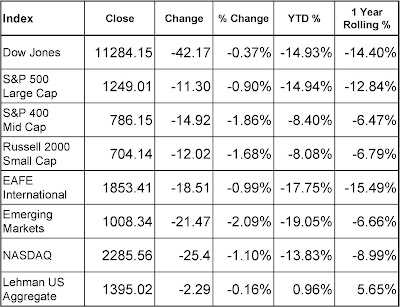
Markets closed lower yesterday after a see-saw ride that lifted the Dow Jones Industrial Average as high as 55.85 points (0.49 percent) and as low as -104.79 points (-0.93 percent). Ultimately, the index closed down 42.17 points (-0.37 percent) as major oil stocks fell along with oil and investors await word from the Fed.

Crude oil dropped $3.69 per barrel or -2.95 percent to close at 121.41 in New York trading. Since the peak of 145 early last month, crude prices have dropped slightly more than 16 percent – a correction, but not yet a bear market (one that we can all enjoy). Still, oil is up more than 25 percent for the year and is only back to prices seen in May.

Market Activity for August 4, 2008

Both personal income and personal spending were higher than Wall Street expected. As noted yesterday, personal income was expected to be lower by -0.20 percent, but actually came in positive at 0.10 percent. Personal spending registered a greater than expected 0.60%, versus the anticipated 0.40 percent.

As mentioned yesterday, one of the key considerations was whether or not consumers were spending their stimulus checks and the data bore that out. I don’t know how I failed to mention it (Brent will have my head), but along with the personal income and spending data came the personal consumption expenditures (PCE) that are considered a key measure of inflation.

The PCE is an index that measures the average increase in price for all domestic personal consumption. If you thought that this would be identical to the Consumer Price Index (CPI), you would be fooled by those tricky economic data collectors.

The CPI uses one set of expenditure weights for several years, where as PCE uses expenditure data from only the current and the previous period. In short, it looks at price changes from one period to another rather than looking at the most recent period compared to some predetermined base period.

The PCE index rose by 0.80 percent in June and gained 4.10 percent from the same month one year ago. Like its ugly cousin CPI, PCE also has a less volatile ‘core’ rate that excludes food and energy. The core PCE rate rose 0.30 percent in June, or 2.3 percent for the year ending in June. The Fed would like the core PCE rate below two percent.

Brent will also be aghast that I forgot to provide any guidance on productivity – one of the favorite measures of our nation’s great fortune. Despite the economic weakness, productivity has grown at an average annual rate of 2.50 percent. For those of you who don’t remember productivity rates in the 1970’s, it was around 0.80 percent.

Set your alarm clock for 2:15 pm EST, when the Fed announces their inaction. As stated yesterday, very few people believe that there will be any change in Fed policy. The key will be the statement. It is widely expected that rates will be unchanged, but that there will also be several dissenters instead of just one. That alone is a signal that rates are headed higher later this year, but the generally fragile nature of the financial system right now is a paramount consideration.

Have a great day!

Dave Ott, General Partner


The Housing and Economic Recovery Act of 2008


The housing bill President Bush signed into law last Wednesday, officially called The Housing and Economic Recovery Act of 2008, looks more like a transcription of the Odyssey in Homeric Greek than it does an attempt to help the everyday American homeowner manage the current mortgage crisis.

However, after reading through the bill itself and listening in on multiple analyst conference calls I will attempt to explain some of the contents of the bill, where it helps the current housing environment and where it falls short.

Government Purchasing GSE Securities

  • GSE’s are the Government Sponsored Enterprises, known more commonly as Fannie Mae and Freddie Mac. These organizations were created by congress but are privately owned by common stockholders. Since their inception, they have had a unique, hybrid role between the public and private sector that is at the heart of today’s crisis.
  • In order to prevent a widespread deterioration of the market for Fannie Mae and Freddie Mac debt, the government has been given the ability to buy any GSE security issue, whether it is debt or equity, by either agency.
  • This announcement has shored up the market prices of the senior debt of both agencies and increased the confidence in their subordinated debt.
  • If the government takes an equity stake in either company, it is unclear what effect this will have on the existing common and preferred shareholders.
  • Treasury Secretary Paulson has said many times that he orchestrated the purchase plan as a confidence booster and doesn’t foresee the need to use it in the future.

Rising Rate of Foreclosures

  • If a particular homeowner is at serious risk of default, they can apply for participation in the refinance program with the Federal Housing Administration (FHA).
  • The FHA will refinance the home up to 85 percent of the newly appraised value as long as the current loan servicer agrees to forgive the outstanding principle balance above and beyond the FHA refinance.
  • To qualify as seriously delinquent, the homeowner must prove that at least 31 percent of gross income is allocated to servicing mortgage debt and loan-to-value (LTV) must be greater than 90 percent.
  • The FHA underwriting standards will remain strict. Therefore, jumbo loans and homeowners who cannot prove the proper documentation of income will not qualify for this program.
  • By participating in the FHA program, the homeowner will sacrifice a portion of the future appreciation of the home, up to 50 percent in certain cases. This, along with a fee paid by Fannie Mae and Freddie Mac on the new securitization business, leaves some hope for this portion of the program to pay for itself.

Government Buying Homes

  • A large amount of funds, about $4 billion, will go to purchasing the glut of already foreclosed homes that currently sit unoccupied.
  • The future for the homes purchased by the government is still unclear. Most home purchases will be in urban areas and will most likely be refurbished and turned into government subsidized housing or simply bulldozed.

First Time Homebuyer Credit

  • A credit for first time homebuyers of ten percent of the value of the home, up to $7,500, will be offered until the end of 2009.
  • Although called a credit, it can be more accurately described as an interest free 15 year amortizing loan.
  • For example, a $7,500 credit will be repaid with $500 added to the homebuyer’s federal tax bill every year for the next 15 years. This can be considered a small incentive at best.

New GSE Regulator

  • In order to police Fannie Mae and Freddie Mac, the government has created a new regulator, The Federal Housing Finance Agency.
  • In addition to assuming all of the responsibilities of its predecessor, the Federal Housing Finance Agency will have fairly open ended discretion over dividend payments, executive compensation and various other aspects of the business.

Problems and Risks with Plan

  • Participation in this program is voluntary. The potential problem with this deals with the shocking number of homeowners that simply walk away from their mortgage without a single call to the lender. The lack of participation in programs for distressed borrowers that already exist poses a challenge for this new program.
  • It will be important to see the principle amounts that loan servicers are willing to forgive. If they are too stringent it may be hard for this plan to get off the ground. It is the responsibility of the loan servicer to maximize the present value of the loan so this will be a difficult decision on their part. It is scary to think that 30 to 40 percent or more principle forgiveness is needed for some borrowers to qualify for this program.
  • Although $4 billion will go towards converting foreclosed property to government subsidized housing, the bulk of the problem lies in suburban homes that are much larger and were purchased by people who couldn’t afford the homes and relied too much on the expectation of continued appreciation. These borrowers won’t qualify for the FHA refinance program because their home value exceeds the limit or they can’t document the level of income needed (or both).

The Long and the Short

The Housing and Economic Recovery Act of 2008 should not be looked at as a “cure all” for the problems that plague the current housing market. If participation in the program goes well it could help to create a bottom for declining home values and reinstate traditional liquidity in housing.

Monday, August 4, 2008

How do currency differences affect investing?

Click here or on the icon below to see David Ott's most recent ASK THE EXPERT column in the St. Louis Post-Dispatch.

Daily Insight


Markets ended the day lower Friday on the larger than expected losses from General Motors (ticker symbol: GM) and rising oil prices. The employment data was relatively mixed and was generally greeted with a sigh of relief even though the headline number went up by one tenth of one percent.

For the day, the Dow Junes Industrial Average (DJIA) closed down 51.70 points to close at 11,326.32, or -0.45 percent. For the week, the Dow lost 0.40 percent, but you would hardly know it as the gyrations were wild – at least 185 points one way or another each day through Thursday.

Crude prices went up by $1.02 per barrel, or 0.80 percent to close at $125.10 in New York. For the week, oil gained 1.50 percent, the first rise over a week for three weeks.


Market Activity for July 31, 2008


Today, we have June Personal Income and spending data at the market open and June Factory Orders at 10:00 a.m. Eastern Standard Time. Personal income is expected to be -0.30 percent and personal spending is expected to be +0.50 percent. The big question will be whether not there is a continued boost from the stimulus checks.

The big story this week will be tomorrow, when the Federal Reserve Open Market Committee (FOMC) announces their Fed Funds Rate and the Discount Rate. The Fed Funds Rate is the interest rate that banks charge each other for overnight loans. The current rate is 2.00 percent. The Discount Rate is the rate that the Fed charges for lending directly to banks and other depository institutions. The current discount rate is 2.25 percent.

Right now, the market expects no change in actual interest rate policy. Any major news will come from their position and comments. Their position refers to the statement that accompanies the interest rate policy decision that describes gives the Fed view on which is worse: inflation or general economic weakness (we long for the days of the third option: a balanced view).

Parsing the statements is a favorite Wall Street pastime. The image may be hard to read, but below is a copy of the most recent statement along with comments about what changed and what stayed the same from statement to statement.

Generally, the Street picks out a few key words to focus on. Last time, for example, when the Fed kept steady for the first time since the credit crunch began, The Street focused on the use of the phrase “uncertainty remains high” when the Fed referred to inflation.

These statements will give clues about whether or not the Fed will begin raising rates by the end of the year. Currently, markets believe that there is a 50/50 chance of a rate hike in October, but those numbers could change quickly depending on what happens tomorrow.

Have a great day!

David Ott, General Partner

Friday, August 1, 2008

Daily Insight

Markets ended the day lower on weaker economic news. For the day, the Dow Junes Industrial Average (DJIA) closed down 205.67 points to close at 11378.02, or 1.78 percent.

On the New York Stock Exchange (NYSE), there were 571 stocks advanced, 1,279 stocks declines and 23 stocks remained unchanged. There were also 33 new highs and 39 new lows.

Market Activity for July 31, 2008
As reported in yesterday’s Insights, the Gross Domestic Product (GDP) figures did not meet expectations for the second quarter and were reduced in the fourth quarter from expansion to contraction. The main contributors were personal consumption (added 1.08 percent), exports (added a huge 2.42 percent) and government consumption (added 0.67 percent). Housing continued to weigh on GDP with residential fixed investment subtracting 0.67 percent, but the big factor was the large subtraction from inventories that dragged down GDP by 1.92 percent.

Additionally, the Labor Department announced that the number of people seeking jobless benefits rose to the highest level in five years, although as Brent has established many times before, this weekly data is very volatile and is generally used as part of a four-week moving average instead of looking at each week independently.

In addition to the economic news, the market also responded to lower than expected earnings from ExxonMobil (ticker symbol: XOM). Although the company reported higher earnings in a single quarter in the history of corporations (a truly remarkable figure – nearly 11.7 billion of profit in a single quarter), it was less than Wall Street had expected (the thought almost 12.9 billion was on deck). The stock fell by 4.86 percent, leading the whole energy sector lower.

In addition to lower profits from XOM, crude oil fell by 2.19 percent or 2.77 per barrel to 124.09 per barrel in New York. This drop extended losses for oil to 11.4 percent for the month of July, making it the largest drop in percentage terms in the 25 year history of the New York Mercantile Exchange.

Wild-man Alan Greenspan hit the airwaves on CNBC just as the bell was about to ring. He told Maria Bartiromo that the U.S. is “nowhere near the bottom” of the housing slump. It’s funny because, two years ago I went to a conference in Washington D.C. where he was a speaker and at that time he told the audience that the worst was nearly over in housing. So much for the maestro –

Today we have what an old colleague of mine referred to as the “jobs jamboree.” The employment report is actually two separate reports that are taken from two separate surveys. The first report is the household survey looks at the employment data by reviewing 60,000 households.

The second part is the establishment survey looks at 375,000 businesses and looks at nonfarm payrolls, the average workweek and average hourly earnings. Generally the market focuses on the establishment survey given the relative size and data dependability.

The unemployment number came in a ticker higher than Wall Street estimates at 5.7%, but this is not terribly surprising after yesterday’s jobless claims number. Nonfarm payroll data came in slightly better than expected this morning and average hourly earnings matched the Street’s expectations, but average weekly hours fell slightly below expectations.

Additionally, we just got earnings from General Motors (ticker symbol: GM) and they are as disappointing as we expected – $15.5 billion second quarter loss. Don’t worry – we weren’t looking to buy – but we were looking at some GM bonds today for the fun of it. Right now issues maturing in 10 years or more are trading at 50 cents on the dollar, which would mean yields of 18 percent per year, assuming all of the payments are made along with getting your money back (obviously, a huge assumption!).

Last but not least, I saw this picture on Greg Mankiw’s blog. He is a professor at Harvard and keeps a timely blog. I thought the picture was great even though Pick n Pay’s are mostly in South Africa and New Zealand.


Have a great weekend!

Dave Ott, General Partner

Thursday, July 31, 2008

Daily Insight

Please accept my apologies for the extremely late Daily Insights this morning. As Brent mentioned the other day, he is on vacation and I plum forgot until I walked in the door.

Market Activity for July 30, 2008

Markets were strong yesterday which was particularly refreshing because it built on the rally the previous day. The S&P 500, the broadest measure of large cap activity, gained 0.80 percent, adding to the 2.30 percent advance on Tuesday.

Instead of a single factor, there were several issues driving the market higher. First, the ADP Employer Services report showed that payrolls had grown by 9,000 jobs this month, while most economists were expecting a loss of 60,000 jobs. This survey isn’t the most important jobs picture, but any good news on employment is greeted positively these days.

Second, the Federal Reserve announced that it would maintain the emergency borrowing plan extended to Wall Street firms through January. 30 of next year. The program was established in March during the most acute phase of the credit crisis when Bear Stearns collapsed and was scheduled to end in mid-September. Other programs were also extended through January that should encourage lending between investment banks.

Third, energy shares were helped by rising oil prices, but those prices didn’t extend to losses on other stocks. Oil gained 4.58 a barrel to 126.77, or 3.75 percent. Large integrated oil companies like ExxonMobil and Chevron gained 4.30 percent 5.34 percent respectively.

Finally, financial shares continued their rally with Bank of America gaining 4.31 percent on top of the 14.83 percent gain on Tuesday. Financial stocks have had an amazing rally since July 15th. Bank of America, for example, has gained more than 80 percent since the low only 15 days ago. This is remarkable rally for a two week period. Obviously, the stock is still well blow prices from even at the beginning of the year, but it does seem to suggest that there is a bottom for financial companies. For the year the stock remains down 15 percent including dividends through yesterday.

Of course, all of this is yesterday’s news. Today, the focus is entirely on the GDP report that shows that the economy grew at an annualized rate of 1.90 percent in the second quarter. While that may seem like good news, it was less than the forecasted growth rate of 2.30 percent and the gains can largely be attributed to the one-time federal stimulus check sent out during the quarter. Housing continues to take its toll on the overall economy.

Whenever a new GDP figure is released, the government also puts out revisions to the previous two quarters. Markets right now are focusing on the revision from the fourth quarter of last year that was revised from a positive figure to a negative number. The first quarter still shows a gain of 0.90 percent, though it is subject to one more revision.

Classical definitions of recession are based on two consecutive quarters of contraction in GDP. However, the organization that now calls recessions, the National Bureau of Economic Research (NBER), now defines a recession this way:

The NBER does not define a recession in terms of two consecutive quarters of decline in real GDP. Rather, a recession is a significant decline in economic activity spread across the economy, lasting more than a few months, normally visible in real GDP, real income, employment, industrial production, and wholesale-retail sales. For more information, see the latest announcement on how the NBER's Business Cycle Dating Committee chooses turning points in the Economy and its latest memo, dated 07/17/03. (Source: http://www.nber.org/)

Therefore, although we haven’t yet experienced two consecutive quarters of recession, the NBER may still call one in the coming months. Generally, the NBER makes their official announcement well into or even after the recession itself.

Stocks opened lower on the news but are now heading back to neutral. If there is anything to be learned by the volatility we have seen this year, though, intra-day movements can be all over the board.

I promise to get Daily Insights out much earlier tomorrow. Also, we now publish Insights along with other articles on our blog, http://www.acropoblog.com/.

Best,


David Ott, General Partner

Wednesday, July 30, 2008

Daily Insight

U.S. stocks rallied yesterday, more than erasing Monday’s declines, as the market continues to be whipsawed. A nice move by the dollar, which helped to push oil prices lower, combined with what may have been a favorable view of Merrill Lynch’s decision to unload mortgage-related securities at a fire-sale price sparked the rally. More on that Merrill news below.

The price of crude for August delivery moved to its lowest level since May, which sent consumer discretionary shares higher – this is the theme these days. When the market rallies, financials and consumer discretionary shares generally lead the way.

Information technology and industrial shares enjoyed a nice day too as better-than-expected earnings results sent the sectors higher.

Market Activity for July 28, 2008

Information technology profits are up 21% with 60% of those names reporting. The capital goods segment of the industrial sector looks good too and may just return to double-digit growth if the business spending trends of the past couple of months continues.

Profit results for eight of the 10 major industry groups remain in positive territory – three have recorded double-digit growth, two have posted 9% or better and another three have recorded earnings growth in a range of 4%-7%. The weakness has occurred in financials and consumer discretionary, down 86.8% (no that’s not a typo) and 21.7%, respectively.

The dollar gained good ground yesterday after the latest home price index showed price declines eased and the July consumer confidence reading improved slightly. Neither report was good, but both were better-than-expected. The dollar’s gain likely was due more to the home price data, which we’ll get to below, than the confidence number, which has proved to be a worthless indicator of future spending for a long time, but I mention it nonetheless.


Oil prices dropped 2.04%, or $2.54 per barrel, to $122.19. With the exception of constructive action out of Congress regarding the self-imposed barriers to production, we need the dollar to rally in order for crude to fall back to desired levels. Fed and tax policy can go a long way in pushing the dollar higher, but this looks quite unlikely for now. So we just have economic data that will drive the $ and oil in the meantime – Thursday’s GDP number will beat current estimates, and the dollar should rally. However, we get non-farm payrolls (NFP) on Friday, which may put pressure on the greenback. So we may be looking at offsetting effects. This increases the importance of the August 5 FOMC meeting; the Fed has a major opportunity to put a dazed oil trade on the mat.


In other news, Merrill Lynch announced they’ll take another $5.7 billion in write-downs in the third quarter – largely from selling $30.6 billion of bonds at a fifth of their face value. This follows $9 billion in write-downs just three weeks ago when they reported second-quarter results. (Merrill had previously valued the $30.6 billion (face value) in bonds at $11 billion. This sale brings the value down to roughly $6.8 billion.)

While these are huge numbers, and carry tremendous costs to existing shareholders, this is a good sign. Merrill is taking their medicine and getting this stuff behind them. One shouldn’t miss that for every loser, there is a winner -- the buyers of these mortgage-related bonds should make out big over time, picking these positions up at 22 cents on the dollar. Absent these fire-sale prices, the losses would have only dragged on.

On the economic front, we received the latest figure from the S&P Case/Shiller Home Price Index for May, which showed a year-over-year decline of 15.78%. On a monthly basis, the index showed prices fell 0.86% (that’s for May from the April reading) and 15.91% at an annualized rate for the three months ended in May.

While these are large declines, the index did offer evidence the degree of price declines may be decelerating. For instance, the three-month annualized figure has eased from down 25% in March and the month-over-month decline has eased from -2.63% in February.

Further, keep in mind that this Case/Shiller index only captures activity among the largest 20 U.S. cities. The largest price declines have taken place in what we’re referring to as speculative areas -- San Diego, LA, Phoenix, Las Vegas and Miami. Detroit has been another major decliner, but this is due to other factors such as auto-sector woes and higher tax rates that have pushed businesses out of Michigan.

Seven of the 20 cities actually showed home price rose in May – Boston, Dallas, Charlotte, Denver, Atlanta, Minneapolis and Portland. So, there was some good news, but the overall point is that Case/Shiller is not a broad index. It does a good job of showing the direction of home prices, but exacerbates the degree to which prices have moved.

The broadest home price index is the OFHEO (Office of Federal Housing Enterprise Oversight) index, which shows home prices are down 6% over the past year. This index has its limitations too, as it captures only conforming loans, leaving out the upper-end of the housing market.

So we must factor in all of the data, it is a mistake to look at just one indicator. For a longer-term perspective I’ll leave you with charts of new and existing home prices. Notice that prices remain nicely positive going back to 1999. It’s tough to read on this graph, but existing home prices are 51.82% higher and existing home prices are up 46.7% from the summer of 1999. (I could only go back to 1999 as the existing median home price index began in that year.) Existing home prices are down 6.41% from the peak and new home sales are down 12.12% from the all-time high.


I’ll be on vacation through August 11 so David Ott, among others, will be filling in until then.

On economic watch over the next week will be the first look at Q2 GDP tomorrow and the July jobs report on Friday. Monday, personal income and spending for June will receive focus and then the FOMC meeting on August 5. For new readers, the FOMC stands for Federal Open Market Committee – the group that sets the Fed’s key interest rate.

We have seen some dissent within the FOMC of late. That is, more members have expressed the need to raise fed funds, gently for now – 20% year-over-year increases in import prices, a 10% jump in producer prices and 5% CPI will have that effect. Anyway, with oil $24 off its record high the Fed may have been lulled into a false sense of security regarding price stability and their comments on August 5 may turn dovish. If so, I believe they’ll be making a huge mistake and oil may rise again. (There are several other factors that determine the price of oil, but one thing at a time for now.)

However, if they show they’re serious about price stability – even with the credit-market challenges that confront the group – we may just see crude forced closer to the $110 level. This presents an awesome opportunity for the Fed and could bring with it a stock market rally, increased consumer consumption numbers and one serious risk removed from the market. It will be interesting to watch this play out.

Have a great day!

Brent Vondera, Senior Analyst

Tuesday, July 29, 2008

Daily Insight

U.S. stocks began Monday’s session lower but looked to reverse course as the indices quickly popped to positive territory in the first 30 minutes of trading; that was until a dire IMF (International Monetary Fund) statement was released about 9:30CT. That release stated there was no end in sight to the housing woes and warned deteriorating credit conditions for consumers and banks may prolong a period of slow growth. (Interesting how they are now reframing their negative predictions as “slow growth” rather than “recession.”)

On this point for a moment, there is no doubt the credit markets are going through a period of trouble, but let’s not act as though things are worse than they actually are. I’ll point out that commercial and industrials loans have risen 18% over the past year and at a 9% annual rate over the past six months. The pace has slowed, but comments that credit has slowed to a halt are removed from reality. Below is a chart of C&I loans.


Losses among the benchmark indices increased in the afternoon after Treasury Secretary Paulson held a press conference that failed to address the market’s chief concerns – we’ll touch on this below.

Market Activity for July 28, 2008
To no surprise, financials and consumer discretionary shares led the market lower – these are the pressure points on days of weakness as concerns over housing, tax rates, price stability and the job market effect these sectors more than any other.

The good news that people should have been focused on yesterday was exactly that IMF report, as this organization’s predictions are rarely accurate. While we expect housing to remain weak for some time still, likely another year due the elevated nature of home supply and higher foreclosure rates, the fact that the IMF has predicted no end in sight may be the best indication the worst is over.

While financials and consumer disc. shares led the indices lower, nothing really helped as all 10 major industry groups were down yesterday. Industrial and information technology shares got wacked with the rest of the market. Utility, energy and basic material shares were the relative winners down 0.19%, 0.46% and 0.58%, respectively.


On the earnings front, outside of the financial sector, things continue to look quite good. Ex-financial profits are up 12% with 55% of S&P 500 members reporting thus far. Seventy-percent of those reporting have beat expectations. Still no one cares right now.

Take Verizon’s results as an example. The phone giant reported Q2 operating profit rose 15.5% as their wireless business was strong. Yet, all people could focus on was their weaker-than-expected landline business. Now, which segment is the growth story? Bad news would have been weak wireless activity, not the case though. So you have a stock that offers a 5.12% dividend yield and is delivering high single-digit profit growth trading at 12.8 times 2008 earnings. And this isn’t even one of the more compelling buys out there. The problem is investors may have to wait a while for attractive returns to materialize, but when they do, it will be big.

For now there are plenty of uncertainties in front of us. The shame of it is policy makers have created most of these uncertainties. A Fed that left rates too low for too long into 2004 and 2005 encouraged the mortgage mess we find ourselves in. The economy was rolling along at a very nice pace, yet they waited until June 2005 to get fed funds above 3.00%. Heck, they were still easing in the back-half of 2003, cutting fed funds to 1.00% in June of that year even as the stock market was signaling a boom and their own June 11 Beige Book report showed things were turning. Now, the same reckless easing policy is on again. Yes they must ensure liquidity and they are doing that via their lending facilities, but to jack their benchmark rate down 325 basis points in nine months (225 of that in six months) is reckless.

And then there is the Treasury Secretary.

Paulson Tries Again

Treasury Secretary Hank Paulson held a press conference yesterday afternoon -- in an attempt to reassure the markets I presume – explaining the virtue of “covered bonds” and the beneficial affect such debt instruments would have on the credit markets. However, while this may be the direction the industry goes over the next several years, it doesn’t do much for now because banks are still set up under the securitization framework – hence, many times they do not hold the assets that back these debt instruments on the balance sheet.

(The way I understand it: Covered bonds are securities issued by a bank and backed by a dedicated group of loans – a “covered pool.” If the issuing bank becomes insolvent, the assets in the covered pool are separated from the issuer’s other assets solely for the benefit of the covered bondholder. This is the major difference between covered bonds and asset-backed securities. Loans backing a covered bond remain on the balance sheet and should the originating bank fail to make payments, interest payments from the underlying mortgages would go to investors.)

Anyway, Paulson’s attempt whiffed, reminiscent of a Dave Kingman strikeout – for you 1970s and 1980s baseball fans, because this is not that which market participants are currently concerned – at least regarding the here and now.

At risk of sounding repetitious, it is the uncertainty over the housing market and its effect on consumer behavior, questions over tax rates, and the possibility/likelihood that the Fed is ignoring price stability.

The housing market will simply take time to correct; after several years of outsized gains, there is nothing Congress or anything other than time can do to fix it. The Fed will do what they are going to do; this is not Paulson’s turf, so nothing he can really do there either. But this is the Treasury Secretary we are talking about, the appropriate person (after the President) to offer tax rate proposals.

What he should be doing is demanding that Congress make the tax rates on capital, dividends and income permanent – as permanent as Washington gets anyway. Follow that up with a proposal to cut the corporate income tax -- which has become one of the highest rates in the world as virtually every other serious country has cut this rate -- and vastly reduce the tax on repatriated income. (This income earned overseas will stay there so long as it is taxed at a 35% rate) You want to bring it home, cut this rate down to single digits; it will come home in droves.

This would combine beautifully with the increased current-year business equipment write-off allowance and bonus depreciation that was delivered in May, and by the way has kicked started business spending as we discussed yesterday. This combination would be a big job and productivity producer, but Paulson doesn’t get it, and thus the market will continue to send the message that he is not delivering what it wants.

Look, these are times the equity investor must deal with on occasion. But this economy is fundamentally sound; allow the housing correction to run its course, get monetary policy back in order and simply do not damage after-tax return expectations by driving tax rates higher and the market will get back on its horse We only need a little tweaking, U.S. businesses are more streamlined than anytime in history, able to compete and dominate on a global scale, but bad policy should not get in the way. Raise tax rates in this environment of intense global competition and you get your hat handed to you.

As of the latest count, there was $3.5 trillion sitting in money-market funds – plenty of capital out there. Give it a reason to come out of hiding and you’re looking at a powerful market run – long-lasting. That said, the equity investor will need patience here, but when things turn, it will make it all worth it.

Have a great day!


Brent Vondera, Senior Analyst

Monday, July 28, 2008

Daily Insight

U.S. stocks gained ground on Friday after better-than-expected economic reports showed a bounce in business spending will help catalyze growth and new home sales rose in two of the four regions. The gains helped the major indices pare weekly losses on the Dow and S&P 500, while the strong 1.33% rise on the NASDAQ Composite moved the tech-laden index to a gain for the week.

The Commerce Department reported durable goods whipped the consensus estimate, with the business spending component jumping 10.4% at an annual rate since March. This number will push the second-quarter GDP figure to a level that easily surpasses the current estimate. The new homes sales number, while weak, didn’t hurt either. The supply of new homes fell, but remains extremely elevated.

Market Activity for July 25, 2008

Information technology shares led the advance, which was nice. Earnings growth has outpaced the rise in share prices for several years with regard to the overall market, but increasing so for the tech sector. Energy and material stocks also helped the benchmark indices bounce back from Thursday’s pummeling after a multi-session pull-back for these shares. Industrials and health-care stocks also rebounded.

On the earnings front, S&P 500 profits remain in negative territory for the second quarter and nothing is going to help this figure move to the positive side with the financial sector weighing so heavily. Financial-sector profits are down 94% for the three months ended June 30 – that’s from the year-ago period. Yet, ex-financial earnings remain in double-digit territory – up 12.1% thus far; roughly 40% of S&P 500 members have reported.

Five of the 10 major industry groups have recorded 10%-plus growth – consumer discretionary (+20.1%), consumer staples (+10.5%), energy (+27.0%), health-care(+10.1%) and information technology (+20.9%). The industrial, basic material, telecom and utility sectors have posted results in a range of 2%-6.8%. Financials is the only sector that’s negative.

In economic news, the Commerce Department reported new home sales dropped at half the expected rate in June and the supply fell for the second month in three. We’ll note that sales have declined 33.2% over the past 12 month, but have increased 13.9% at an annual rate over the past three months.

That last comment is encouraging, but the report does not account for cancellations of previously signed contracts, so the new home sales data is not the most reliable. (Existing home sales, although working with a bigger lag that new homes is probably a better indicator as sales are not counted until the closing, rather than when signed like new homes sales.)

Too, this figure is quite volatile and the next couple months of data can pull the rug from any optimistic thoughts – just something to keep in mind. If this trend of the past quarter continues, however, it may signal the housing sector is beginning to stabilize, but it will take more data to make this conclusion realistic. That said, I think the non-speculative regions of the market – those excluding California, Arizona, Nevada and Florida – may be showing a bottom in prices. Those four states are big ones though, five of the biggest 20 cities reside in California and Florida alone, which will weigh on the overall figure.


In terms of region, the Northeast saw new home sales increase 5.3% in June; sales rose 2.5% in the Midwest. The South and West regions showed declines of 2% and 0.9%, respectively.

In a separate report, Commerce showed durable goods orders for June easily surpassed the consensus estimate, rising 0.8% overall and the ex-transportation number, which has posted a gain in three of the past four months, jumped 2.0%. The estimate was for a 0.3% decline on the overall reading and a 0.2% decline in the ex-trans number.

Total durable goods orders have fallen 0.3% at an annual pace since March. Excluding transportation – which takes out the extremely volatile commercial aircraft orders and a beleaguered auto sector – orders have jumped 13.5%.

As mentioned in Friday’s letter, we were focused on the business spending figure and it didn’t disappoint -- up1.4% in June and 10.4% at an annual rate for the last three months. The shipments of this segment – technically known as non-defense capital goods ex-aircraft – increased 5.9% at an annual rate during the second quarter. This number feeds right into the GDP figure and we’ve got a great shot at seeing a 3.0% real rate of growth for Q2. This would be huge considering housing continues to subtract a full percentage point from the figure.

Big gains in electrical equipment and machinery orders were the catalyst for the capital goods segment. Industrial machinery orders were up 13.8% annualized past three months and 11.8% over the past year. Electrical equipment more than doubled, up 150% over the past three months – again that’s annualized – and 8.4% past 12 months.


In other news, the Senate passed the housing bill, which the President Bush will sign this morning I suppose. The bill involves the Fannie Mae and Freddie Mac provisions that would allow the Treasury Department to increase its credit line to the two GSEs, Treasury to take an equity stake if needed, and raise the size of loans eligible for purchase to $625,000 – that ceiling will depend on the region.

The centerpiece of the legislation is the program of $300 billion of FHA-insured mortgages to help refinance loans for those who cannot afford their current situation. The way I understand it, lenders would have to get a new appraisal on the property and then write it down by 15% from there for the homeowner to qualify. In return, the homeowner will have to share, equally, future price appreciation with the FHA. And if home values go down before they go back up, and the borrower goes under, then of course the taxpayer is on the hook.

Also, in the legislation is up to a $7500 tax credit for first-time homebuyers. They would have to buy between April 2008 and June 2009. That’s a big credit and may just kick sale up a bit; we shall see.

Have a great day!

Brent Vondera, Senior Analyst