
U.S. stocks remained in rally mode on Monday after a good retail sales report and Asian countries’ pledge to maintain stimulus spending. As a result, energy and basic material (commodity-related shares) led the advance.
The largest daily gains over the past couple of weeks have followed policymakers’ statements that aggressive monetary and spending policies will continue. For instance, the broad market jumped 1.92% the day following the latest Fed meeting in which the FOMC stated conditions warrant “exceptionally low levels of the federal funds rate for an extended period.” Then the S&P 500 rallied 2.22% a week ago Monday after the G-20 members agreed to continue stimulus spending. Now we have this 1.45% move yesterday, which immediately followed the pledge from APEC (Asia Pacific Economic Cooperation). The impetus for these rallies appears to be pretty obvious.
To be sure, the retail sales data had something to do with the rally. Or rather what it didn’t do, it didn’t damage the higher sentiment that was evident by pre-market futures trading. A number of segments within that report showed decent-to-solid growth, but the ex-autos number did miss expectations and the downward revision to the previous month was substantial. The overall reading easily surpassed expectations, but only because auto sales bounced from a very weak September reading -- the autos sales chart below tells it all.
 Advancers trounced decliners by an eight-to-one margin on the NYSE Composite. Volume was unimpressive as less than 1.1 billion shares changed hands.
Market Activity for November 16, 2009
 Bernanke’s Dollar
Whoa! The Fed chairman not only mentioned but spent considerable time talking about the dollar, and the corresponding increase in commodity prices, in yesterday’s speech to the Economic Club of New York. Of course, he had to point out that he believes inflation will remain subdued for some time (and he may be right so long as credit continues to contract, but the moment it picks up so will the velocity of money and all of those dollars pumped into the system will cause prices to rise, and fast).
The Dollar Index spiked on the news, but quickly plunged back to where it was trading before the comments. The markets will require action, talk is not nearly sufficient to reverse the dollar down trade – but if this is a first step we’ll take it. Is this an early signal the Fed is thinking about a little ratcheting? Let’s think about that.
 If mildly increasing fed funds shows the world that the Fed is somewhat serious about keeping the dollar from drowning in a sea of aggressive monetary easing, it will make their eventually unwinding of current policy much easier. Conversely, if they keep ZIRP in place and the dollar heads lower, commodity prices keep flying and traders continue to push stocks to valuations that do not appear to be commensurate with realities on the ground, then the Fed’s job in the months ahead will become all the more politically unsavory. The longer they wait, the more aggressive the tightening campaign will be and this will be very harsh on asset prices. I know I’m reaching here. It’s highly unlikely the Fed will move on rates before the unemployment rate peaks (and we’re at least six months from this occurring). But allow me to dream for a moment.
The market surely didn’t view his statements as anything but lip service as stocks kept chugging along and the Dollar Index moved down to the 74 handle and then to intraday lows. The dollar bounced off of that low mark but finished below the day’s average price – as you can see above.
Retail Sales
The Commerce Department reported that retail sales jumped 1.4% in October (+0.9% was expected) after a big downward revision to the previous month – down 2.3% vs. the -1.5% initially estimated.
The overall gain in retail sales for October was mostly due to a bounce in auto sales after a very weak September. (Of the $4.7 billion increase in sales, autos accounted for $4.0 billion.) But we did get good results from the apparel and general merchandise segments – there’s that colder weather event we talked about; last month marked the third-coldest October on record.
Excluding autos, retail sales rose 0.2% (following a downwardly revised 0.4% increase for September. The ex-auto reading was weighed down by a large 2.4% decline in building materials. Take out autos, building materials and gasoline (what’s known as core retail sales and the number that feeds directly into the personal consumption reading for GDP) and retail sales were up 0.5% for the month – that gets the fourth quarter off to a good start.
Quickly on that building materials decline, this is a pretty bad sign for residential home construction. Home building added to GDP last quarter for the first time in 13 quarters. The increase in this area will probably prove fleeting.
Autos (motor vehicles and parts) jumped 7.4% in October. Gas station receipts were flat after rising for two months in a row. The segment is down 15% year-over-year.
Clothing and general merchandise looked good as sales for those segments rose 0.4% and 0.8%, respectively. Eating, drinking (the segment that I often refer to as unfazed by high joblessness as a significant portion of this reading involves 20-somethings) jumped 1.2%.
Furniture, electronics, sporting goods, and again that building materials reading, were all down.
From a year-over-year perspective, overall retail sales are down 1.7% from the very weak October 2008.
Empire Manufacturing
New York-area manufacturing activity grew in November but at a reduced rate relative to October. The Empire Manufacturing index came in at 23.51 for the month (6.5 points below the expectation) after a 34.57 in October. A reading above zero marks expansion, so this is a good number even if it missed the forecast. (This differs from the ISM and Chicago manufacturing surveys in which a reading of 50 is dividing line between expansion and contraction.) That big reading for October (the best since 2004) seemed to be artificially boosted by auto assemblies following clunker cash.
In terms of the sub-indices, new orders fell to 16.66 from 30.82 in October. Delivery times fell to -2.63 from 3.90 in October – this shows firms are having no problems delivering orders even with the slashing of payrolls, not a particularly good sign for job gains. Employment fell to 1.32 from 10.39. However, these are the first back-to-back positive readings since the spring of 2008.
The two readings getting most attention right now – inventories and average workweek – were not helpful.
Inventories ticked up to -17.11 from -18.18, but remain well in contraction mode. We have yet to receive evidence that firms feel comfortable enough to boost stockpiles – and that means production remains lackluster.
 The average workweek reading fell back to 5.26 after bouncing to 20.78 in October. We were waiting to see some extension to that previous reading, for sure current employees will have to see their hours worked increase dramatically before factories bring back those who have been laid off. It is good to see this reading in positive territory, but after the aggressive manner by which manufacturers have slashed payrolls, this measure needs to post a series of outsized gains in order to deliver an addition to factory employment anytime soon.

Business Inventories
The Commerce Department reported that business inventories fell 0.4% in September, the slowest rate in a year, showing what the latest GDP reading also illustrated – inventory slashing has ended. To be sure, stockpiles continue to be cut, firms have neither the confidence nor the demand to begin to rebuild, but this is an important first step. Auto inventories jumped in September, due to very weak sales for the month. Excluding auto, business inventories fell 0.6%.
The sales data attached to this report showed a decline of 0.3% after three-straight months of increase. The inventory-to-sales ratio held at 1.32 months worth of supply. This reading probably needs to fall back to 1.25 (near the record low) in order to get firms building stockpiles again in this environment.
Economists are watching for a build in ex-autos stockpiles as evidence the inventory dynamic has arrived – this is what will catalyze GDP for a couple of quarters. I’m guessing the first and second quarters of 2010. Many readers may notice I keep pushing this estimate forward. A couple of months back I had estimated the inventory dynamic would be in full swing by the fourth quarter. We’re still waiting for its arrival.
Have a great day!
Brent Vondera, Senior Analyst
The largest daily gains over the past couple of weeks have followed policymakers’ statements that aggressive monetary and spending policies will continue. For instance, the broad market jumped 1.92% the day following the latest Fed meeting in which the FOMC stated conditions warrant “exceptionally low levels of the federal funds rate for an extended period.” Then the S&P 500 rallied 2.22% a week ago Monday after the G-20 members agreed to continue stimulus spending. Now we have this 1.45% move yesterday, which immediately followed the pledge from APEC (Asia Pacific Economic Cooperation). The impetus for these rallies appears to be pretty obvious.
To be sure, the retail sales data had something to do with the rally. Or rather what it didn’t do, it didn’t damage the higher sentiment that was evident by pre-market futures trading. A number of segments within that report showed decent-to-solid growth, but the ex-autos number did miss expectations and the downward revision to the previous month was substantial. The overall reading easily surpassed expectations, but only because auto sales bounced from a very weak September reading -- the autos sales chart below tells it all.
Advancers trounced decliners by an eight-to-one margin on the NYSE Composite. Volume was unimpressive as less than 1.1 billion shares changed hands.Market Activity for November 16, 2009
Bernanke’s DollarWhoa! The Fed chairman not only mentioned but spent considerable time talking about the dollar, and the corresponding increase in commodity prices, in yesterday’s speech to the Economic Club of New York. Of course, he had to point out that he believes inflation will remain subdued for some time (and he may be right so long as credit continues to contract, but the moment it picks up so will the velocity of money and all of those dollars pumped into the system will cause prices to rise, and fast).
The Dollar Index spiked on the news, but quickly plunged back to where it was trading before the comments. The markets will require action, talk is not nearly sufficient to reverse the dollar down trade – but if this is a first step we’ll take it. Is this an early signal the Fed is thinking about a little ratcheting? Let’s think about that.
If mildly increasing fed funds shows the world that the Fed is somewhat serious about keeping the dollar from drowning in a sea of aggressive monetary easing, it will make their eventually unwinding of current policy much easier. Conversely, if they keep ZIRP in place and the dollar heads lower, commodity prices keep flying and traders continue to push stocks to valuations that do not appear to be commensurate with realities on the ground, then the Fed’s job in the months ahead will become all the more politically unsavory. The longer they wait, the more aggressive the tightening campaign will be and this will be very harsh on asset prices. I know I’m reaching here. It’s highly unlikely the Fed will move on rates before the unemployment rate peaks (and we’re at least six months from this occurring). But allow me to dream for a moment.The market surely didn’t view his statements as anything but lip service as stocks kept chugging along and the Dollar Index moved down to the 74 handle and then to intraday lows. The dollar bounced off of that low mark but finished below the day’s average price – as you can see above.
Retail Sales
The Commerce Department reported that retail sales jumped 1.4% in October (+0.9% was expected) after a big downward revision to the previous month – down 2.3% vs. the -1.5% initially estimated.
The overall gain in retail sales for October was mostly due to a bounce in auto sales after a very weak September. (Of the $4.7 billion increase in sales, autos accounted for $4.0 billion.) But we did get good results from the apparel and general merchandise segments – there’s that colder weather event we talked about; last month marked the third-coldest October on record.
Excluding autos, retail sales rose 0.2% (following a downwardly revised 0.4% increase for September. The ex-auto reading was weighed down by a large 2.4% decline in building materials. Take out autos, building materials and gasoline (what’s known as core retail sales and the number that feeds directly into the personal consumption reading for GDP) and retail sales were up 0.5% for the month – that gets the fourth quarter off to a good start.
Quickly on that building materials decline, this is a pretty bad sign for residential home construction. Home building added to GDP last quarter for the first time in 13 quarters. The increase in this area will probably prove fleeting.
Autos (motor vehicles and parts) jumped 7.4% in October. Gas station receipts were flat after rising for two months in a row. The segment is down 15% year-over-year.
Clothing and general merchandise looked good as sales for those segments rose 0.4% and 0.8%, respectively. Eating, drinking (the segment that I often refer to as unfazed by high joblessness as a significant portion of this reading involves 20-somethings) jumped 1.2%.
Furniture, electronics, sporting goods, and again that building materials reading, were all down.
From a year-over-year perspective, overall retail sales are down 1.7% from the very weak October 2008.
Empire Manufacturing
New York-area manufacturing activity grew in November but at a reduced rate relative to October. The Empire Manufacturing index came in at 23.51 for the month (6.5 points below the expectation) after a 34.57 in October. A reading above zero marks expansion, so this is a good number even if it missed the forecast. (This differs from the ISM and Chicago manufacturing surveys in which a reading of 50 is dividing line between expansion and contraction.) That big reading for October (the best since 2004) seemed to be artificially boosted by auto assemblies following clunker cash.
In terms of the sub-indices, new orders fell to 16.66 from 30.82 in October. Delivery times fell to -2.63 from 3.90 in October – this shows firms are having no problems delivering orders even with the slashing of payrolls, not a particularly good sign for job gains. Employment fell to 1.32 from 10.39. However, these are the first back-to-back positive readings since the spring of 2008.
The two readings getting most attention right now – inventories and average workweek – were not helpful.
Inventories ticked up to -17.11 from -18.18, but remain well in contraction mode. We have yet to receive evidence that firms feel comfortable enough to boost stockpiles – and that means production remains lackluster.
The average workweek reading fell back to 5.26 after bouncing to 20.78 in October. We were waiting to see some extension to that previous reading, for sure current employees will have to see their hours worked increase dramatically before factories bring back those who have been laid off. It is good to see this reading in positive territory, but after the aggressive manner by which manufacturers have slashed payrolls, this measure needs to post a series of outsized gains in order to deliver an addition to factory employment anytime soon.Business Inventories
The Commerce Department reported that business inventories fell 0.4% in September, the slowest rate in a year, showing what the latest GDP reading also illustrated – inventory slashing has ended. To be sure, stockpiles continue to be cut, firms have neither the confidence nor the demand to begin to rebuild, but this is an important first step. Auto inventories jumped in September, due to very weak sales for the month. Excluding auto, business inventories fell 0.6%.
The sales data attached to this report showed a decline of 0.3% after three-straight months of increase. The inventory-to-sales ratio held at 1.32 months worth of supply. This reading probably needs to fall back to 1.25 (near the record low) in order to get firms building stockpiles again in this environment.
Economists are watching for a build in ex-autos stockpiles as evidence the inventory dynamic has arrived – this is what will catalyze GDP for a couple of quarters. I’m guessing the first and second quarters of 2010. Many readers may notice I keep pushing this estimate forward. A couple of months back I had estimated the inventory dynamic would be in full swing by the fourth quarter. We’re still waiting for its arrival.
Have a great day!
Brent Vondera, Senior Analyst


 Banks are required to hold a certain amount of cash at the Fed, called required reserves. Excess reserves, cash that banks chooses to hold at the Fed in excess of the required amount, have grown since the Fed began pumping the system with cash. The reason for this is lack of demand for funds by both households and businesses – basically banks have nothing to do with all the liquidity. The graph below shows the level of reserves, both required and excess, that banks currently hold at the Fed.
 True money creation is more than just Fed induced liquidity. Money creation will only happen if there is adequate demand for money, and right now there isn’t. Excess liquidity has a track record of producing high levels of inflation, but the lack of demand for loans is keeping inflation in check right now.
 Crude Oil
 Continuing claims fell for an eighth-straight week, down 139,000 to 5.631 million, although more because of traditional benefits running out than job creation, as the exhaustion rate chart illustrates below.
 Extended benefits also show there is some expiry going on as the EUC (Emergency Unemployment Compensation) program showed claims rise (more recent laid off workers moving from traditional to EUC), while extended benefits fell (the longer-term unemployed exhausting the extensions).
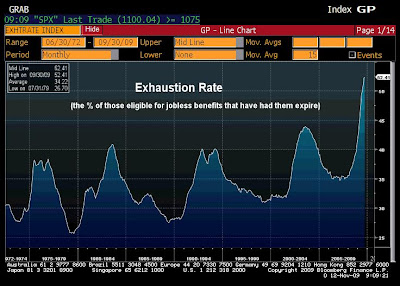 All in all, the claims data suggest that the pace of firings continues to decline, yet a pick up in hiring has yet to become evident.
 Holiday Sales, and More Importantly Spending Trends Beyond
 The Dollar
 There doesn’t seem to be any policymakers (at least domestically) who currently see a falling dollar value as a problem. For sure, the conventional wisdom views this as a good thing in that it will boost U.S. export activity. If the dollar continues to decline, we’ll see yet again how flawed conventional wisdom can be.
 Clearly, economically-sensitive stocks have been outperforming strongly, something that one expects in bull, not bear, markets. “Cyclical” sectors outperformed in the eight months since the S&P 500’s bottom, with the financials sector jumping 140.6%, the consumer discretionary sector adding 81.5%, the materials sector growing 78.6% and the information technology sector gaining 77.7%. In contrast, “defensive” sectors like healthcare, utilities, and telecom underperformed.

 October Jobs Report
 Over the past six months jobs losses have averaged 272,000 per month, this is a huge improvement from the previous six months in which losses averaged a super-high 645K per month. The current level of job losses has finally moved to a range that is no longer at the deep levels of the prior three recessions and that is an important development – for the short term, and I’ll explain what I mean by this below.
 The U6 jobless rate – this figures includes the official jobless rate, plus those marginally detached (those too discouraged to look for work during this survey period), and those working part time because they can’t find full-time work, which probably reflects labor-market torpor more than anything else -- jumped to 17.5% in October from 17.0% the previous month. This measure was re-calculated in 1994, so we can only view it to that point.
 In terms of its previous methodology the U6 jobless rate hit 14.0%, which is still below the postwar record of 14.3% hit in 1982.
 The duration of long-term unemployment (the percentage of the unemployed that have been out of work for over 27 weeks) held at the record high of 35.6%.
 The average weekly hours worked data fell back to the record low (data goes back to 1964) of 33.0 from 33.1 in September – it’s dropped back to this record low three times now. Unfortunately, we’ll need to see this figure head to 34.0 before employers even think about adding jobs. The average over the past decade is 33.8 hours per week.
 Productivity
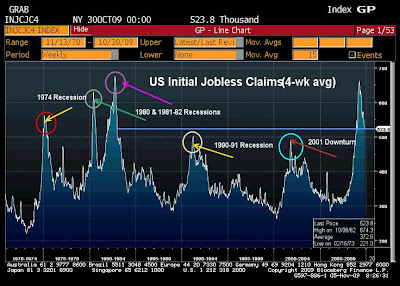 Continuing claims fell for a seventh-straight week, down 68,000 to 5.749 million. As we’ve touched on for weeks now, this reading is being distorted by the exhaustion of benefits, which as of the latest payroll data continues to climb to record levels – as of September the exhaustion rate of the unemployed who had been collecting jobless benefits rose to 52.4%. Tomorrow’s data will shed new light on this reading.
 (Also part of that bill is an extension of the homebuyers’ tax credit of $8,000 to April 30. Buyers who have owned their residence for at least five years would qualify to receive a $6,500 credit if they buy another – they would not have to sell the current home but the new one would have to qualify as their primary residence. Singles making up to $125,000 and couples making up to $225,000 would qualify. The market distorting games continue.)

 Mortgage Applications

 In terms of region, the South endured the heaviest level of coming layoffs last month as employees announced 22,818 cuts. There were 17,187 announced layoffs in the West, 10,453 in the Midwest, and 5,221 in the East.
 This level of job losses remains in line with pretty heightened level of monthly job losses during the typical recession. We’ve seen the level of losses fall from extreme levels, but they will have to move to the minus 100k-150K level per month before we begin to get excited that firms have moved past this very damaging job slashing phase.
 Gold
 Bianco Research
 The gain in factory orders marks the fifth increase in six months. From here we will see if it is sustainable, it will all depend on the timeline with which final demand arrives. If it is lacking, due to a persistently high jobless rate, we won’t get that full-blown inventory dynamic we’ve been waiting for and that will show up in the production numbers.
